Archive for the ‘Football’ Category

Winneshiek’s Return to Carlisle

November 3, 2009

William Phineas Winneshiek, Winnebago from Hatfield, Wisconsin, wasn’t a star football player at Carlisle but surely had friends that were. He probably played on a shop team or for the band, because he was a musician. After leaving Carlisle in 1915, he played semi-pro football for the Altoona Indians and, in 1916, assisted fellow Altoona Indian and musician, Joel Wheelock, coach the Lebanon Valley College team. In 1922 he played in the NFL for the Oorang Indians. However, music was where he made his living. A website maintained by his grandson includes photos of Winneshiek: http://firstpeople.iwarp.com/phineus.html

On December 11, 1936, Bill Winneshiek, who was then known as Chief Winneshiek (probably because he was descended from a hereditary chief) wrote Hugh Miller to thank him for giving him some photographs of the Indian School. He also expressed his feelings about what he saw on his recent visit to the old school:

Mr. Miller, I know that you are one of the few White men living that will realize fully the great injustice that was brought upon the Indian Race when Our Great Democratic Government decided to: “Take Away From The Redman The Last Remaining Treasure (Carlisle Indian School) He Had in U. S. A.

Buildings had been burned down; complete destruction of the tall smokestack, which once answered the purpose of a monument; The Campus , which was once the pride of all who saw it for it was kept always in its natural beauty by the Indian students had faded into an unkept meadow; Our school mates who had been called by the Great Spirit and laid at rest near the Athletic Field, had been disturbed and moved to a more lonelier spot by the soldiers who now inhabit the Grounds where the American Indian made his last stand. No Government, no Race of People could have been more Cruel, No Christians, whether they be White, Yellow, Brown, Black or Red, could forget Providence long enough to commit that one last barbarous act as when Carlisle Indian School was taken from the Red Man. The saddest thing that has yet befallen the Indian.

Carlisle’s Most Important Game

October 30, 2009

The following question was posed to me this week:

I have to do a college speech on an event in the 20th century. I decided to do it on a Carlisle Indian School football game and how that particular game brought attention to the school, the players, and the whole story behind it. If you had to pick ONE game that, in your opinion, put the Carlisle Indian School and their football team on the map what game would you pick.

This is a very difficult question to answer because there are several possibilities:

1. In just their third full season of football, the Indians played The Big Four (Princeton, Yale, Harvard and Penn) in successive weeks and were competitive in all four games. A bad call cost them the Yale game and they held Harvard to just four points. National Champions 10-0-1 Princeton beat all of their opponents except Lehigh, Army and Harvard worse than they beat the 5-5 Indians. The Tigers were held to a scoreless tie by Lafayette. Carlisle smashed Penn State 48-5 and beat the previously unbeaten Champions of the West Wisconsin 18-8.

2. In Pop Warner’s first year at Carlisle, the Indians notched their first win over a BIG FOUR team, Penn, 16-5. They also beat California 2-0 in a game played on Christmas Day in San Francisco. Halfback Isaac Seneca was named to Walter Camp’s All America First Team, the first Carlisle player to be so honored.

3. The 10-1 1907 Indians beat a BIG THREE team for the first time when they took Harvard 23-15. They also beat Penn 26-6, Minnesota and Chicago. Their only loss was to Princeton. Warner considered the set of players on this team to be Carlisle’s best and Jim Thorpe was on the bench! The win over Amos Alonzo Stagg gave him much personal satisfaction.

4. The 11-1 1911 team also beat both Harvard and Penn. Warner considered this team to be Carlisle’s best but it lost to Syracuse by one point due to overconfidence and listless play. Clark Shaugnessy ranked the 1911 Carlisle-Harvard game as one of the twelve best games of all time. Jim Thorpe described it as his most favorite game of his long career.

5. The importance of the 1912 Carlisle-Army was debunked in “Jude and the Prince,” an article written by James G. Sweeney and published in the May 2009 journal of the College Football Historical Society.

I’d appreciate reading your opinions regarding Carlisle’s most important game.

Lonestar Played in the NFL

October 19, 2009

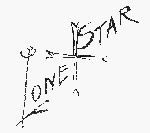
Not long ago, I learned that some Carlisle Indians other than the ones on the Oorang Indians also played in the NFL. Chris Willis’s book, The Columbus Panhandles, tells the story of one of the charter members of the NFL (called the American Professional Football Association when it was first formed in 1920). The 1920 Panhandles’ roster included one player that claimed Carlisle Indian School as his alma mater. That was Frank Lone Star. John Steckbeck’s classic about the Carlisle Indian School football teams, Fabulous Redmen, makes no mention of him playing football. An appendix to Willis’s book lists Frank as having played guard and tackle in three games in the 1920 season. A search of newspaper coverage for these games confirms Willis’s data.

Unfortunately, Carlisle’s school records don’t indicate that Frank Lonestar ever played football there—at least not on the varsity squad. Frank Lonestar, Chippewa from Shell Lake, Wisconsin, first arrived at Carlisle in August 1903. After completing the five-year term, he re-enrolled for a three-year term. Just before the end of that term of enrollment, he ran away but re-enrolled in September 1911. He ran away again, returned in March 1912, and left for good in May 1912. While at Carlisle, he learned the printing trade and could have played on the Printers’ shop football team. Shop teams received little press, so it’s not known for sure if he played for them. He kept in touch with the school while working in Cleveland, Ohio. He died at his brother’s home in Shell Lake on October 30, 1915.

Frank’s untimely death made it impossible for him to play for the Columbus Panhandles in 1920. Playing under assumed names was common in the early days of professional football, especially by people whose employment might be jeopardized if their employer learned they were playing football for money.

One possibility is Lone Star Dietz because he was looking for a coaching job at that time. He went by the name William Lone Star at Carlisle. That name is close to Frank Lonestar. Also, Dietz would have likely known that Frank was dead because his death was announced in The Carlisle Arrow. In addition, Frank’s hometown was in the county immediately north of Dietz’s. Tackle was his natural position, too.

In 1920, Lone Star Dietz was 36, an advanced age for an athlete in that era, a factor that would explain him playing only three games. Of course, it may not have been Dietz, but if it wasn’t, who was it?

Pretty Boy – part 3

October 5, 2009

A May 4, 1915 letter from Superintendent Campbell of the Cheyenne River Agency to Oscar Lipps, Superintendent of Carlisle Indian School, stated, “…you are advised that Pretty Boy and Thomas Hawk Eagle represent one and the same person.” Carlisle officials continued to call him Thomas Hawkeagle as they had always done.

Sports reporters followed suit. Thomas Hawkeagle made the varsity squad in 1914. He didn’t start the first game of the season against Albright College, but got some playing time at right guard in place of Captain Elmer Busch. That pattern continued pretty much through the season. On December 6, in a game played in Atlanta against Auburn, he apparently became part of a football legend. The Auburn website cites a possible origin of the War Eagle cheer:

The 1914 contest with the Carlisle Indians provides another story. The toughest player on the Indians’ team was a tackle named Bald Eagle. Trying to tire the big man, Auburn began to run play after play at his position. Without even huddling, the Auburn quarterback would yell “Bald Eagle,” letting the rest of the team know that the play would be run at the imposing defensive man. Spectators, however, thought the quarterback was saying “War Eagle,” and in unison, they began to chant the resounding cry.

The problem with this explanation is that Carlisle had no player named Baldeagle or War Eagle. However, as we know, Hawkeagle was on the team. The Washington Post coverage of the game reported that Hawkeagle substituted for Hill at left guard in this game. Hawkeagle could have been misunderstood as War Eagle. Thomas Hawkeagle may live today if this attribution of the legend is true.

Next time – Part four of Pretty Boy’s tale.

Pretty Boy

September 28, 2009

The next few blogs will be a little different from those done in the past. I’ve encountered a person whose story probably won’t fit neatly into any of my upcoming books, so I’ve decided to serialize it on the blog. I don’t know how many installments will be required because it’s just being written now. After reading the first installment, someone who knows things about the person may see it and provide information about him that I don’t know. Here goes.

 Pretty Boy, as he was known on the Cheyenne River Agency in South Dakota (postal address Dupree, SD) thought he was born in February 1893 when he applied for enrollment at Carlisle Indian School on September 1, 1912. When he registered for the WWI draft, he thought his date of birth was April 14, 1893. Perhaps he learned something about his background in the intervening period.

He was an orphan when he applied, but it isn’t known for how long yet. When he was examined at CIIS by Dr. H. B. Fralic, he was found to be in good health with the exception of his eyes which were considered suspicious by the examining physician. His father died of unknown (to him) causes and his mother died of tuberculosis. He had a sister who was in good health.

Prior to coming to Carlisle, Pretty Boy attended school in Rapid City, South Dakota from 1903-1906. In 1906, he transferred to Cheyenne River Boarding School, which he attended until he left for Carlisle. Being a large young man at 6’1” tall, Pretty Boy was a natural for the athletic teams. Weighing just 163 3/ pounds, he was light for his height, but Pop Warner probably figured that he could fatten him up a bit.

Next time – Part two of Pretty Boy’s tale.

Bob Carroll

September 24, 2009

I post this blog with much sadness and gratefulness. Today’s mail brought the new issue of The Coffin Corner and opened it with great anticipation as I always do. This time an extra sheet was enclosed. Sadly, it announced the demise of Bob Carroll. Bob Carroll co-founded the Professional Football Researchers Association in 1979 and has worked tirelessly for it these past 30 years. As a favor to me, he drew the frontispiece for my recent book. A reproduction of his artwork follows. I will miss seeing his drawings in future issues. His obituary follows.

Robert N. Carroll Jr.

North Huntingdon

Robert N. Carroll Jr. North Huntingdon Robert Nuehardt Carroll Jr., 73, of North Huntingdon, died Tuesday, Aug. 25, 2009. He was born July 10, 1936, in Wheeling, W.Va., the son of the late Robert Nuehardt Carroll Sr. and the late Katherine Foran Carroll. He was a retired art and English teacher at McKeesport High School and was a writer of several books on sports. He is survived by his wife, Suzanne Sprowls Carroll; daughter, Katherine Aileen and her husband, Chris Potter, of Brownwood, Texas; son, Martin David “Hoss” and his wife, Cynthia Carroll, of North Huntingdon; brother, Charles H. Carroll, of Parkersburg, W.Va.; grandchildren, Maizy Lynn Carroll, Kyra Aileen Potter and Nicole Lynn Benevento; great-grandchildren, McKenna, Dominick and Caleb; sister-in-law, Aileen Beery, of Wheeling; and nieces and nephews. There is no visitation. Services are private. Arrangements are by the GILBERT FUNERAL HOME AND CREMATORY INC., 6028 Smithfield St., Boston, Elizabeth Township. Memorial contributions may be made to the Pro Football Hall of Fame, 2121 George Halas Drive, NW, Canton, Ohio, 44708.

Frontispiece

Fielding Yost Offered Carlisle Job

September 8, 2009

As always, when I search for information on one topic, I find unrelated, but interesting information on something else. This time I came across an article in the January 14, 1907 edition of The Lake County Times about the state of Michigan athletics—the University of Michigan, that is. The article, dateline Ann Arbor, Mich., Jan. 13, discussed the University’s dissatisfaction with conference rule changes. The changes apparently dealt with eligibility and would hurt its track team. “Michigan appears to be hit the hardest by this rule for she will lose five of last year’s conference point winners. These five men took no less than forty-two points In the last meet, and now that they are out It looks as though Michigan will not shine very brightly in the conference this spring”

 “The blow has been dealt and if Michigan remains in the conference to be dictated to by such colleges as Northwestern, Purdue, Minnesota and Indiana, with whom she has, absolutely no athletic relations except during the one-day general conference track meet, there will be the sorest bunch of collegians in Ann Arbor that ever was collected together.” As the reporter expected, Michigan dropped out of the conference and stayed out for about a decade. However, the article included a tidbit of more interest to me.

“Yost, Fitzpatrick and Baird have ambitions. Fielding Yost draws $3,500. He had an offer of $5,000 to go as coach for the Carlisle Indian School and turned it down because things were agreeable here.” The last statement may or may not have been true. Had Carlisle offered Yost the job, the offer had to have been tendered much earlier. Articles were printed in late December, 1906 announcing that Warner was leaving Cornell and returning to Carlisle. Also, Albert Exendine wrote that he had been informed late in the 1906 season that Warner would be returning. This was before Fielding Yost officiated the Carlisle-Vanderbilt game. I wouldn’t say that Yost and Warner feuded but it is clear that Yost did not like Warner. Whether this incident factored into that any way is not known.

The Indians’ Most Bitter Defeat

August 27, 2009

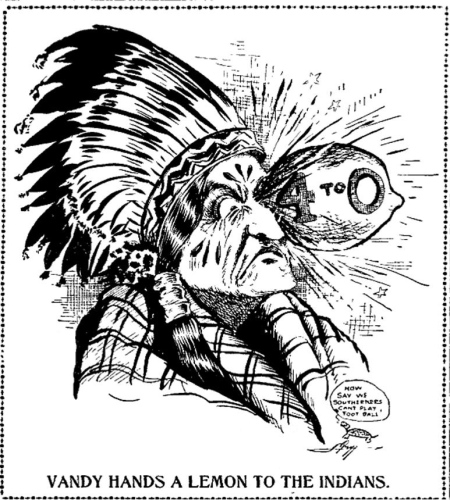
Elsewhere in the article mentioned in the previous post,Paul LaRoque, whose nickname was Barrel, discussed the greatest disappointment in his athletic career, the 1906 Carlisle-Vanderbilt game. This game received no mention in the Indian School press or in Steckbeck’s book, possibly because it was added while the team was on a road trip and the Indians played Minnesota five days earlier and Cincinnati two days later, winning both games handily.

He scored two touchdowns against the Commodores but both were called back. Referee for the game was Michigan’s Fielding Yost and he apparently didn’t like the guard-around play that Carlisle ran so successfully. He ruled it illegal even though it was run routinely in the east that year. A century later, high schools occasionally run the guard-around against aggressive defenses. Rather than snap the ball to the quarterback or tailback, the center leaves the ball between his feet as he charges forward. One of the guards pulls back from his position, picks up the ball and runs around the end for a long gain.

Unfortunately, Fielding Yost wasn’t the only obstacle the Indians had to overcome. “We were bitter about that defeat….We had reservations at the biggest hotel in Nashville, but, when we arrived they told us there weren’t enough rooms available and sent us to a small hotel. All the boys on the squad and the team doctor got sick after our evening meal on the eve of the game. We spent most of the night running to the bathroom. We all felt that Vandy was going to win that game one way or another.” The reporter observed that LaRoque was still unable to smile about the experience.

Vandy

Indians Will Work

August 20, 2009

While looking for information concerning Chauncey Archiquette’s time at Haskell, I came across a newspaper article unrelated to him (I think) that seemed curious. The fact that this reporter seemed to have no qualms about making statements that Indians were lazy, implies that it was a common belief and was not a controversial position at that time. If it is accurate that the 40 Haskell students were football and baseball players, it is likely that several of them also attended Carlisle Indian School at some time. If they were good players, they probably made it a point to go east.

Indians Who Actually Work

It has always been a theory among westerners that, an Indian—a fullblood—would not work. But all this summer 40 Indians from Haskell institute have been at work for the Santa Fe [Railroad], near Emporia. Side by side with them a gang of Greeks has been employed, and the railroad bosses say the Indians excel the Greeks in every way. Indeed, it is acknowledged that the Indians made the best workmen of any engaged on the road, and there are gangs of several nationalities employed near Emporia. All summer these Indians, many of whom belong to the football and baseball teams at Haskell, have kept up their practice in these games. They never seem too tired to play a game of ball, and they have beaten all the teams in the neighborhood.—Kansas City Journal

Guyon’s Groupie

August 17, 2009

Groupies are not a new phenomenon. Today I came across a 1903 article in the Lincoln Daily News with a Denver dateline with a sensational headline. FLED HER HAPPY HOME FOR INDIAN HALFBACK was followed by Beautiful Young Pueblo Girl Shows Her Infatuation for Guyan[sic], the Chippewa on Haskell Team. The article began, “In love with handsome Charles Guyan[sic], the full-blooded Chippewa halfback on the Haskell Indian football team, pretty Bertha Hodkinson of Pueblo, ran away from home and the team and Guyan were shadowed by relatives, with the result that the girl was caught today.”

The football hero in question is Charles Guyon (aka Wahoo) who enrolled at Carlisle in 1905. A detective was assigned to him the entire time he was in The Mile-High City for the game with Denver University. The reporter thought that the girl, “who is but 17 years old…had evidently been warned, for she did not join him then, nor attempted to do so until noon today.”

Guyon told Detective Emrich that he hadn’t seen Bertha since August when she wrote him to ask for his autograph. “He became acquainted with her in a casual way while travelling with the team last year, and her sixteen years were greatly impressed with his manly charms. ‘But I don’t want to be mixed up in any trouble,’ said Guyan. ‘I know these young girls, and if she comes here I’ll point her out to you. I don’t want trouble.’” When she appeared at the Metropole Hotel and asked for him, Guyon telephoned the detective who rushed to the hotel and arrested her.

Bertha told a different story, “No, I wasn’t stuck on the Indian. I only came to Denver to see the game and visit my friend, Mrs. Eisenhart of 1011 Thirteenth Street.” She claimed that it was always her intention to return home after the game. Mrs. Eisenhart said that she had no previous acquaintance with Miss Hodkinson, that the girl merely rented a room in her house while she was in town. The girl said that she was 18 years old and free to travel if she wishes. She had also bought a round-trip ticket.