Archive for the ‘Football’ Category
January 11, 2011
After reflecting on the matter a little, I recalled that Frank Hudson had lived in Bucks County when the two prior censuses were taken in 1920 and 1910. Perusing those censuses revealed that the Buckingham Township farm on which Frank Hudson lived and worked was owned by Charles (S. or L.) Smith and his wife Ruthanne Rockefeller Smith. Charles was French-speaking due to being born in Alsace-Lorraine. However, the 1910 census listed him as being German. Perhaps his origin was modified after WWI. The elderly Smiths apparently died between 1920 and 1930, probably leaving the farm to one or both of their daughters.
Frank Hudson was classified as Indian in 1910 but, from 1920 on, was listed as being white. It appears that he stayed with the Smiths from the time he left Carlisle. His student file indicates that he started working for a C. Smith in Lingohocken, Bucks County, Pennsylvania in 1894 and following years. His “Report After Leaving Carlisle” listed him as working as a farm hand in Wycombe, Pennsylvania in 1909. (Wycombe and Lingohocken appear to be unincorporated areas near each other.) S. J. Nori reported that, beginning in 1910, he was farming on shares (sharecropping) in Wycombe. Given that the 1910 census placed him on the Charles Smith farm in 1910 and that Smith was already in his mid-70s at that time, it is logical that Frank was farming on shares instead of just working as a hired hand. That he stayed on for at least another decade as indicated by the 1930 census argues for him having more of a stake in the farm than as a hired hand. Whether he ever obtained an ownership position remains to be seen. That will probably require a trip to Doylestown to unravel.
Tags:Charles Smith, Lingohocken, Ruthanne Rockefeller Smith, Wycombe
Posted in Carlisle Indian School, Football, Frank Hudson | Leave a Comment »
January 6, 2011
The Spruance Library in Doylestown, Pennsylvania, the seat of Bucks County, has a tiny bit of information on Frank Hudson in their files: “Frank Hudson, died Dec. 24, 1950 in Wycombe, PA.; full blooded Pueblo Indian. Leaves no known relatives.” While it’s not a lot of information, it tells us some important things we didn’t know before. We now know the exact date and general location of his death. It supports but does not affirm our belief that he didn’t marry and didn’t have any children. One newspaper article—a couple of sentences at most—used the phrase “on his farm” when announcing his death. For decades after leaving Carlisle, it was reported that he worked on a farm in Bucks County, so his living on a farm at the time of his death wasn’t surprising. Now to research where he was living.
The 1930 census listed Frank Hudson, 50, as living with sisters Clara and Edna Smith, 60 and 45, respectively. These three ages were probably the census taker’s approximations. Clara was listed as a farmer and Frank as a laborer. Edna’s occupation was listed as “none.” Perhaps she was disabled or otherwise unable to work. She may even have functioned as cook and housekeeper because farmer’s wives’ occupations were also categorized as “none” on this page. The operation was listed as “general farm” as were others on the page. The three of them were likely living on a diversified farm, the norm for that day and place. The sisters were probably spinsters as both had marital statuses of S(ingle). Neither was widowed or divorced.
I called the Bucks County Courthouse to determine if they had any other information on Hudson. No will was probated for him after his death. That probably means that he owned no property solely in his name if at all. The Recorder of Deeds Office has a number of properties owned at one time by Frank Hudsons. It will take a trip to Doylestown to see if any of them were our Frank Hudson.
Tags:Bucks County, Clara Smith, Doylestown, Edna Smith, Pueblo, Spruance Library, Wycombe
Posted in Carlisle Indian School, Football, Frank Hudson | Leave a Comment »
December 30, 2010
In one of my earliest blogs, I mentioned learning something at the very first book talk I ever gave. That began a trend as it is not unusual for an attendee to inform me about something I didn’t know. At a recent talk at a nearby retirement home, a resident asked me about Emerson Metoxen. About all I knew about him was his name because he attended Carlisle Indian School in its latter days after athletics were deemphasized. So, I was of little help to the woman who asked if I knew anything about the man she called “Uncle Chief.” I thought little further about the conversation as I am behind schedule on several projects until I received a letter in the mail.
That letter contained two old newspaper articles about Emerson Metoxen, one of which was written after he was inducted into the Lebanon Valley College Hall of Fame and the other after he died in 1989. Also included was what appears to be a flyer that tells about Metoxen’s activities at Valley Forge summer camps after his retirement as an educator. All three pieces contain biographical information about him. His achievements after leaving Carlisle were many and his life story deserves documenting.
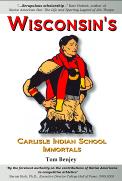
But where to document his well-lived life is the question. He had the misfortune of being too young to star on the great Carlisle teams as he was just getting playing time as a substitute when WWI brought football at Carlisle to an end. So, he doesn’t fit well into Wisconsin’s Carlisle Indian School Immortals. However, he was an Oneida and several Oneidas’ life stories are included in that book. Perhaps a smaller (and less expensive to buy) book focused on Oneida football players would provide an appropriate place to tell his story. I’d like to hear (read) your thoughts on that idea.
Tags:Chester High School, Emerson Metoxen, Lebanon Valley College, Radnor Jr. High, Valley Forge, York College
Posted in Carlisle Indian School, Football | Leave a Comment »
December 28, 2010
Historians are familiar with Carlisle’s impressive victories over Army, first in 1905 and later in 1912. But few know that Carlisle almost replaced Navy as the Cadet’s end-of-season foe in 1913. Newspapers started hyping the 1913 football season in early August that year. First, it was announced that, “The Army, after several years of defeat by the Navy, is going to follow a new policy this season and there are few hard games on the soldiers’ list. A new feature of Army’s schedule will be a game on November 1 with Notre Dame.” On August 8, a news report datelined Trenton, NJ announced that negotiations were being held to move the Army-Navy game to the local fairgrounds. An August 12 news report out of Annapolis reported that, “Army and Navy football managers are at loggerheads over arrangements for the annual football game. The date is to be Nov. 29. West Point has objected to the number and situation of seats accorded them at Philadelphia and proposed the game be played at West Point and Annapolis alternatively or in New York every year. Navy stands pat on Franklin Field at Philadelphia.”
The August 28 Washington Post announced that the 1913 Army-Navy game was off and that, on that very day, Pop Warner would be signing a contract for the Carlisle Indians to play Army at West Point on November 29. The next day’s paper blared, “West Point-Carlisle Game Is Officially Announced,” “General Dismay at Naval Academy,” and “Took It for Granted That Game Would Eventually Be Arranged.” Army and Navy officials in Washington retained hopes that the inter-service game would yet be played.
On September 2, Navy officials threatened to break off all relations with West Point unless the school’s football teams meet on the playing field that year. The day after that, the Secretary of the War Department called a meeting with the two academies’ athletic directors and hammered out an agreement for Army and Navy to meet on November 29 at the Polo Grounds in New York City. The Washington Post reporter covering this story mused, “Just how Army will get out of the Carlisle muddle remains to be seen.”
Tags:Polo Grounds, Washington Post
Posted in Carlisle Indian School, Football, Pop Warner, William Garlow | Leave a Comment »
December 17, 2010
Reviews of the programs for the athletic banquets for years 1908-10 (Carlisle’s athletic banquets covered calendar years not school years) found no mention of John Russeau (in any of the various spellings). That means that he didn’t get enough playing time in any of the varsity sports to letter at Carlisle. That he appeared in the 1908 team photo shows that he was on the team, probably as one of the scrubs. That he was assigned the task of coaching the Painters implies that Pop Warner thought he understood the game well enough to teach younger players how to play the game. Unfortunately, he is also credited with some things that he most likely didn’t do.
For example, his Rice Lake Hall of Fame biography includes this statement: “John played at tackle and end on both sides of the line and scored two touchdowns, one on a 20 yard pass reception against Baltimore College in 1906 and the other on a fumble recovery in the end zone against Carlisle Prep College.” The Carlisle varsity never played a Baltimore College. However, Baltimore City College was playing high school teams around that time and may have played Carlisle’s Second Team (sometimes called “The Hustlers”). There was no school called Carlisle Prep College but Dickinson College did have a preparatory school, (called Conway Hall from 1905 to 1917) that Carlisle’s varsity annihilated in 1908 53-0 when the season opener with Albright College fell through because they didn’t field a team that year. It’s quite possible that John Russeau recovered a fumble in the end zone against them because everyone got to play in blowouts like that one. He may have gotten into the game with Mt. St. Mary’s if it had materialized.
The Second Team was to play home games against the Swatara team of Steelton on October 10 and Conway Hall on Thanksgiving. They were also to play road games in Washington and Baltimore. The Third Team (also called “The Hustlers”) also had a schedule of games against athletic clubs, college reserves and prep schools. John probably played in several of these games, one of which was played in Baltimore against Walbrook Athletic Club. This punting contest played in a snowstorm which made it unlikely that Russeau caught a pass in that game. He probably played in several second and/or third team games and may have scored in some of them. But there is no evidence found of him playing in a varsity game.
To be continued…
Tags:John Roussian, John Russeau, John Russian, Rice Lake Hall of Fame, The Hustlers, Walbrook Athletic Club
Posted in Albert Exendine, Carlisle Indian School, Football, Pop Warner | 2 Comments »
December 14, 2010
A 1951 Rice Lake Chronotype article about john Russeau stated that he had been at Carlisle Indian School from 1906 to 1910. The Carlisle Arrow article about him coaching the Painters football team in 1909 seems to support that he was involved in the football program and that he was at Carlisle in the 1909-10 school year. Further research is needed to learn more about his time there. The 1951 article also included some of Russeau’s observations of Pop Warner that, to my knowledge, haven’t been reported elsewhere but are consistent with what is known about “The Old Fox” including what he has written about himself.
Russeau described Warner as “a strict disciplinarian who would take no excuses for ‘holding back’ by his players and who enforce rigorous training by the whole team. His favorite penalty for rule infractions, according to John, was a long cross-country run, with the player in full football uniform. ‘Pop’ made sure the delinquent did not lag in his run—from one to five or ten miles—by following along on horseback.”
While this might seem far-fetched, it is quite possible because horses could still be found in the stables on Carlisle Barracks. The Model T Ford was not put into production until 1908 and few could afford automobiles before that. Cavalry officer Major William A. Mercer was superintendent of Carlisle Indian School part of the time Russeau was there and kept his horse on campus. Mercer’s successor, Moses Friedman, also had horses—or at least his wife did. The Carlisle Arrow of May 28, 1909 reported that Mrs. Friedman’s horse fell on her and broke her thigh bone. Also, horse were used on the school’s farms and were likely readily available for Warner’s use. It is quite possible that Mercer or Friedman welcomed Warner’s riding as exercise for their horses.
To be continued…
Tags:John Russeau, Moses Friedman, Rice Lake Chronotype, William A. Mercer
Posted in Carlisle Indian School, Football, Pop Warner | Leave a Comment »
December 9, 2010
The school newspaper items establish that John Russeau (Russian) was indeed at Carlisle Indian School in 1909. Perusing the index of Carlisle Indian School student records uncovered a file for John Roussian, Chippewa from Wisconsin. This could be our man. However, it will be necessary to go to the National Archives in Washington, DC to see it or wait for the Archives to make a copy of the file and send it to me. Contents of student files vary widely, so exactly what I will find is unclear. Frequently, one finds student cards for each three or five-year enrollment (students often re-enrolled for further schooling), that include information such as arrival and departure dates, a parent’s name, whether parents are alive or dead, and the places the student went on outings. Such information would be helpful in this case.
Louie Foss of Rice Lake sent me copies of old Rice Lake Chronotype articles about John Russeau that were accompanied by photographs. I showed the articles to Richard Tritt, photoarchivist at Cumberland County Historical Society. He had recently looked at a couple of team photos from The Philadelphia Press, one of which was of the entire team not just the starters and most-often-used substitutes. On the left end of the front row was a person named Russian. One of the photos in a Chronotype article was the same person cropped from the team photo and blown up a bit. This shows that John Russian of Carlisle and John Russeau were one and the same person.
Richard noticed that the lettermen generally wore different jerseys than did the players who didn’t usually get into varsity games. The new jerseys worn by the starters that year did not have the quilted padding on the shoulders as did the older ones. Russian’s jersey had the padded shoulders which implied that he didn’t get much playing time with the varsity. He may have played a lot in the second team’s games but records for them are sketchy.
To be continued…

Tags:John Roussian, John Russeau, John Russian
Posted in Carlisle Indian School, Football | 3 Comments »
December 6, 2010
Lone Star Dietz was inducted into his home town’s Hall of Fame in 2002. On Sunday, another Carlisle Indian was honored similarly by Rice Lake, Wisconsin. John Russeau, who spent much of his youth nearby in the town of Hayward in adjoining Sawyer County. He graduated from Superior High School in Douglas County, which is a bit further north along, not surprisingly, Lake Superior. He began his football career at Superior High School from which he graduated in 1905. After that, he played a bit for the Hayward Indian School team from his then home town. About then, he enrolled at Carlisle Indian School in Pennsylvania.
John’s name was first mentioned to me almost a decade ago by local Rice Lake historians but I found nothing about him relating to the Carlisle football team. I didn’t do an exhaustive search but, finding nothing about him in Steckbeck or in game reports I had looked at while researching Lone Star Dietz, who was at Carlisle while John was there, I concluded that he wasn’t a starter on the varsity team and forgot about him.
Later, I learned that he might have also been known as John Russian. While reading Carlisle Indian School newspapers as part of the research for Wisconsin’s Carlisle Indian School Immortals, I came across two articles in The Carlisle Arrow in which he was featured. On April 30, 1909, it was reported that he paid the school a visit while in the country on outing. He reportedly said that he was living in a good home and was being paid good wages. The second mention was in the November 26, 1909 edition. That one focused on sports:
“The Painters football team came out victorious over the Specials last Saturday, in a struggle for the shop team honors, by the score of 6 to 20. As the Painters have won all their games thus far their success reflects the earnest efforts of their coach, John Russian, in rounding out such a good team from so few candidates.”
To be continued…
Tags:Hayward Indian School, Rice Lake, Sawyer County, Superior High School
Posted in Carlisle Indian School, Football, Lone Star Dietz | Leave a Comment »
December 2, 2010
Pop Warner made many observations regarding his Carlisle Indian players, almost all regarding their behavior, much of which he thought was a result of their culture. But on one occasion he discussed an anatomical difference he had observed. Warner claimed that the lower legs of white boys and Indians were different. It was his observation that one group’s lower legs dropped straight down from the knee whereas the other’s curved outward.* It was this difference that gave the Indian boys an advantage in kicking the football over white boys.
Warner often mentioned how his Indian players would practice some skill endlessly, in some case for years, until they perfected it. An example was Frank Hudson who drop-kicked footballs year round including when there was snow on the ground. He simply moved indoors to the gym during inclement weather. Hudson also practiced with both feet until he became ambidextrous (it’s not clear if ambipedal is a word) and was able to dropkick field goals with either foot. He also became the game’s best dropkicker, arguably of all time. In addition to practicing a skill, Warner noticed that that the Indians watched proficient players’ closely to learn a skill. An example he gave was of Mike Balenti kicking four field goals, two from over 40-yards away, against Navy without having attempted one in a game before. Balenti attributed the success to his having watched Hudson and Frank Mt. Pleasant.
Warner thought that many more Carlisle players were good at kicking than were the white players he coached before and after because of a physiological advantage. He believed that the shape of Indians’ lower legs was better suited to kicking. It would be interesting to know if Warner was seeing things or if what he said is true.
*I misplaced the article in which Warner stated this and would appreciate it greatly if someone could inform me as to where I can find it.
Tags:Drop kick, dropkick, field goal
Posted in Carlisle Indian School, Football, Frank Hudson, Frank Mt. Pleasant, Mike Balenti, Pop Warner | 4 Comments »
November 29, 2010
Pop Warner is viewed by most historians as the great football innovator and especially for his work at Carlisle Indian School. However, not all the innovations at Carlisle were Warner’s brainchildren. In 1906, the Indians were coached by former players Frank Hudson and Bemus Pierce who Warner helped prepare for the revolutionary rule changes that were implemented that year. After Warner departed for Cornell to start his season, Hudson and Pierce were pretty much on their own. But that wasn’t much of a problem. The Carlisle Indians were called a lot of things but witless wasn’t one of them.
One of the major rule changes was the legalization of the forward pass. Completing a pass wasn’t the easiest thing to do, particularly when both teams wore similar brown or black leather helmets. Passers needed a way to identify the eligible receivers. So, during the very first season in which the forward pass was legal, the Indians experimented with special helmets to help the passer find his target. The November 21, 1906 edition of The Lake County News described this early attempt at receiver identification. Five players wore snow white helmets and one wore a blazing red one. The article used the term headgear rather than helmet which, given the early state of helmet development, is probably more accurate. Given that the four backs and two ends are eligible to receive passes, the total of six special helmets makes sense. It seems fair to surmise that the red one would be worn by the player who does most of the passing and that the white ones are worn by those who can go out for passes.
In 1933, Michigan State started using a winged helmet for all its players to differentiate their men from the defenders. Less than a decade later, Lone Star Dietz’s Albright College team painted crosses on the tops of the receivers’ helmets but didn’t invent that idea as it had been used before, possibly even at Carlisle.
Tags:Forward pass, Painted helmets, Winged helmets
Posted in Bemus Pierce, Carlisle Indian School, Football, Frank Hudson, Lone Star Dietz, Pop Warner | Leave a Comment »




 Tom Benjey's Weblog
