Archive for the ‘Football’ Category

More 1903 Carlisle All Stars

February 9, 2012

Walter Camp didn’t name any other Carlisle players to All-America team teams that year but James Johnson wasn’t the only Carlisle player to receive an honor. Walter Camp also picked an All-Western Team for 1903 “from the University teams of the Middle West,” essentially the teams that would become the Big Ten plus Notre Dame. “What does this have to do with Carlisle Indian School?” you say. Plenty.

Camp’s All-Western Team included Ed Rogers, Captain of the 1903 University of Minnesota team, at end and James Phillips, Northwestern University guard. Perhaps Camp shed some light on his picks when he wrote, “Rogers is an Indian, experienced, quick, and certain” and “Phillips is another Indian, and as he would not play against Carlisle, Northwestern’s line was correspondingly weakened. That game also showed what a large part Phillips had been in Northwestern’s defense.” Rogers and Phillips had both starred at Carlisle before leaving to embark on careers as lawyers. While at Carlisle, Rogers had taken courses at Dickinson College and Dickinson School of Law while playing football for Carlisle. However, in 1898 as a Dickinson College student, Ed played for Dickinson in their game against Penn State. The college’s school newspaper claimed that he was a bona fide player because Carlisle’s season was already over and he was a legitimate student enrolled in the college. However, his Dickinson College football career was limited to that one game. Later, he starred at Minnesota and captained his teammates to a 6—6 tie with Fielding Yost’s undefeated Point-a-Minute team in the first Little Brown Jug battle.

James Johnson and Ed Rogers were eventually inducted into the College Football Hall of Fame. James Phillips ended his collegiate football career at the end of the 1903 season, married, and migrated west to Aberdeen, Washington where he had an illustrious career, but that is a story for another time.

The story of Carlisle Indians starring for colleges and universities in 1903 is far from complete…

1903 Carlisle All Stars

February 7, 2012

The 1904 Spalding Guide includes various pundits’ All Whatever Teams, ranging from Walter Camp’s annual All America teams to others’ nationwide selection to various regional teams composed of who they thought were the best players from the 1903 season.  Not surprisingly, some Carlisle players’ names were included in some of these selections.  More surprising was that some former Carlisle stars were listed but as members of other teams, usually major universities!

Walter Camp named James Johnson to his All-American Team for 1903 First Eleven at quarterback, saying this about him:

“Johnson, captain and quarterback of the Indian team, demonstrated in his Harvard and Pennsylvania games his ability as a strategist as well as his power as a quarter-back. He is versatile, watches the ball splendidly, understands how to use his men, and plays so as to get good work out of them, and finally is a dangerous man on field-kick goals.”

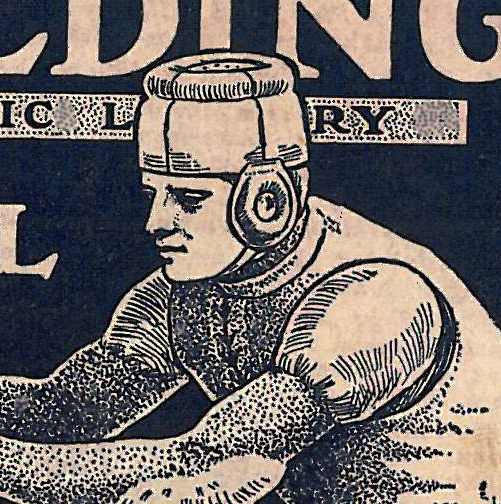
Johnson’s photo differs from that of the other All Americans in that he is wearing a helmet. About half wear their playing clothes while the others sport their letter sweaters. Only Johnson wears his headgear. Perhaps Spalding selected this photo of him because he was wearing something that looks a lot like Spalding’s Head Harness No. A, which at $5.00 made it, along with the equally priced Pneumatic Head Harness No. 70, Spalding’s most expensive headgear at the time. (Less expensive headwear options started at $1.50.) Modern readers might find Spalding’s ad copy for Head Harness No. A interesting:

“Made of firm tanned black leather, molded to shape, perforated for ventilation and well padded. Adjustable chin strap. This head harness presents a perfectly smooth surface, and while giving absolute protection is one of the coolest and lightest made. When ordering specify size of hat worn.”

Next time, more on 1903 Carlisle Stars.

1903 Football Deaths vs Other Sports

January 24, 2012

We’ve discussed football deaths for 1905 previously but the concern over deadly violence did not begin at that time.  Concern existed well before that.  The 1903 Spalding’s Guide includes the result of a study on football injuries but, before we look at that, we will focus our attention on a December 4, 1903 article that was run across the country. This article reported 17 deaths and 64 serious injuries for the season just ended. Not included were what the writer called local or scrub teams or the carnage from the railroad accident involving the entire Purdue team.  “They are simply the deaths and accidents that occurred in noted games. And the record for this season is nothing unusual. It is just about an average with other seasons.”

The writer was evidently not a supporter of football as it existed at that time. He compared football to boxing and found fewer serious injuries in boxing although it attracted more attention from legislators. When he compared football to bullfighting, football came out as worse because the bulls would be eaten for food and the horses used in bullfighting were destined for the glue factory anyway. Also, bulls and horses alike were killed in combat, a much more desirable way to die than at a packing plant. He went on to compare bullfighting with fox hunting with dogs and horses in not very complimentary terms as another example of a sport over which Americans preferred football. He further criticized Americans’ taste by pointing out that if the 20 hunters already dead and the five more dying in Northern Wisconsin because they were mistaken for deer by other hunters were killed by Spaniards, Russians or the Chinese, we would view them as being very stupid.

Pneumatic Helmet Introduced in 1903

January 17, 2012

 As shown on the left, the player depicted on the cover of the 1903 Spalding Guide wears an odd-looking piece of headgear not seen in previous editions. Although it resembles cranium adornments sometimes found on pre-Columbian art, it is of more recent invention. It is different from anything I had seen in earlier photographs and drawings. When perusing the advertising pages at the back of the 1903 guide, I came across a full-page ad for “Spalding’s Pneumatic Head Harness (Patented),” an item that looks suspiciously similar to the headgear in the cover drawing. A couple more pages including a few more models of head harness (Spalding didn’t call them helmets in those days) are sprinkled among the advertisement pages at the end of the book.

 This one was apparently Spalding’s latest and greatest at the time. The pneumatic head harness, model number 70, cost $5.00, $2.00 more than their next highest-priced model. In Spalding’s words:

 This represents really one of the greatest improvements that has so far been invented in the way of equipment for foot ball. It is made of soft black leather with an inflated crown. The pneumatic part of the head harness is sufficient to give ample protection with space left for ventilation through heavy wool felt….When ordering specify size of hat worn.

No mention is made of how one is to inflate the headpiece. Perhaps the “Club” Foot Ball Inflater, priced at 50¢, or the Pocket Foot Ball Inflater, at half the price, could be used to keep the head protector at full pressure. Because this design didn’t last long (it is not in the 1916 book that was close at hand), it is fair to conclude that it didn’t perform as well as expected—and as advertised.

Carlisle’s 1918 Schedule

January 13, 2012

Yesterday’s mail brought the 1918 Spalding Guide. It includes a couple of interesting things about the Carlisle Indians. First off, the team photo (of the 1917 team) shows the players in different jerseys than we’re accustomed to them wearing. These appear (the small photo on the yellowed page isn’t the clearest) to have two stripes above the midriff and above the elbows on the sleeves. I think I may have seen one of these jerseys before, possibly in Wardecker’s store.

 About all that was written about the 1917 team, their last as things turned out, was what George Orton of the University of Pennsylvania, wrote in his piece about the mid-Atlantic region : “Carlisle showed improvement over the previous year, but until they get a team of first rate caliber they will do well not to schedule so many matches with the big colleges.” Perhaps, he thought Carlisle had been playing opponents well above their weight since 1914. Their 1917 schedule was brutal, causing the overmatched Indians to lose by huge scores to the likes of Army, Navy, Penn and John Heisman’s Georgia Tech, arguably the best team in the country that year.

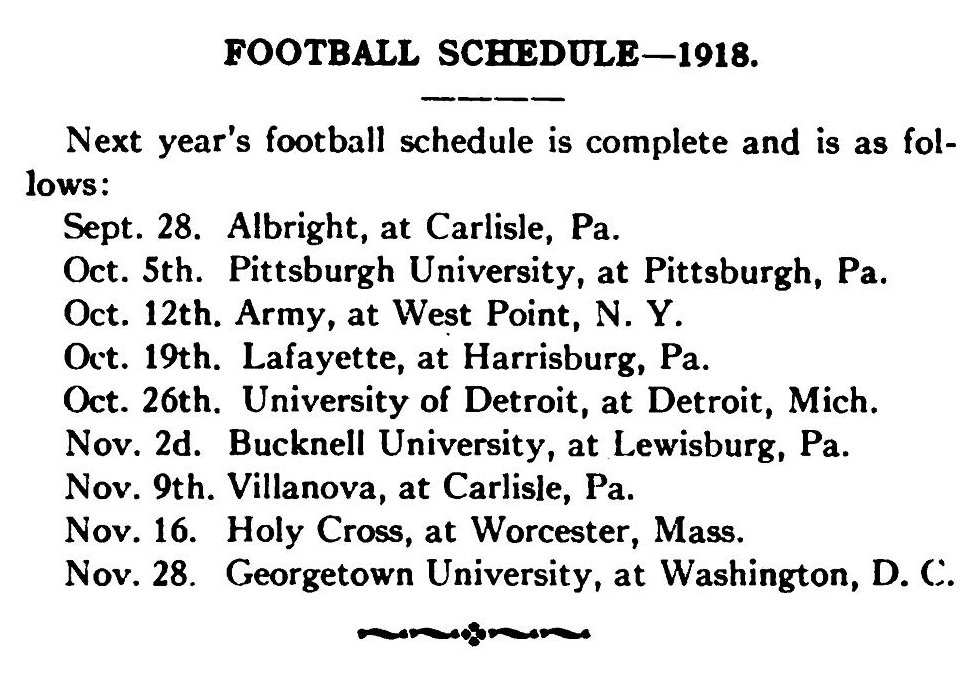
 The Guide also includes schedules for most college and university teams as well as some prep school and high schools. Because Carlisle largely played against colleges and universities, its games were listed with theirs and not in the Scholastic schedule. Although the schedule wasn’t nearly as tough. It included Army and Pitt, the team that would be deemed National Champions for 1918. The schedule was as printed in the Carlisle school newspaper on May 24, 1918 except for the October 26 game with Detroit which wasn’t ultimately scheduled.

 Orton didn’t even hint that Carlisle was about to close. The published schedules included Carlisle. Had it been know well in advance of the football season that Carlisle Indian School was closing, their games would have been stricken from the list. This is further evidence that Carlisle’s closing was not inevitable after the 1914 Joint Congressional Investigation.

 By the way, Cornell’s 1917 jerseys again had stripes just below the elbow.

Cornell Wore Plain Jerseys in 1903

January 10, 2012

Among other things, today’s mail brought a copy of the 1904 Spalding guide and it provides some valuable information with regard to determining who first used football jerseys with stripes below the elbows.  A photograph of the Cornell team on page 30 captured most of the team members in their playing uniforms, not their letter sweaters.  The black and white photo has the players wearing dark-colored jerseys under what Spalding called sleeveless football jackets.  The v-necked jackets laced up the front and were cut back where sleeves would have been connected, had there been any, to provide freedom of movement for the players’ arms.  All of the sleeves, necks and a bit of the bodies of the jerseys were visible with the jackets on.  One assumes that the jerseys were solid carnelian, a brownish shade of red, because Cornell’s school colors are that color and white.  The school colors were chosen as a (possibly humorous) reference to the University’s founders, Ezra Cornell and Andrew Dickson White.  Those who are associated with the school are commonly referred to as “Cornellians” and the reddish-brown color is sometimes spelled cornelian.

From the photo of what was most likely the 1903 Cornell team because photos had to be submitted to Spalding well before the start of fall practice in order for the guide to be laid out, printed and distributed ahead of the beginning of 1904 football season.  The Carlisle team photo on page 22 of this book is definitely that of its 1903 team because Pop Warner is in it and James Johnson is holding the football.  Johnson was captain of the 1903 Carlisle team and played for Northwestern in 1904.  Warner returned to Cornell for the 1904, ’05 and ’06 seasons.  As reported previously, Cornell was wearing jerseys with stripes below the elbow in 1905 as shown in the 1906 Spalding guide.  I have to wait for the 1905 guide to arrive before seeing if they had shifted to the unusual stripe configuration for Warner’s first year back at his alma mater (unlikely unless Warner had nothing to do with it).

Were Carlisle’s Jerseys Unique?

January 6, 2012

As mentioned in this blog previously, I am in process of reprinting the Spalding Football Guides for the years that Carlisle Indian School fielded a team.  That process is progressing well but I have not yet found the 1901 and 1911 books as yet and don’t hold much hope of coming across books for the years from 1894 to 1898.  Be that as it may.  I am already discovering interesting things without having a full set.

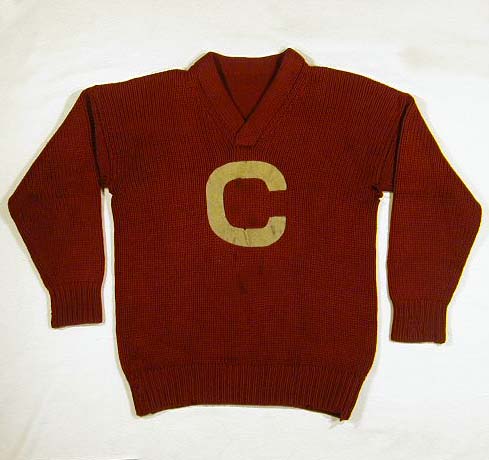
While flipping through the 1906 volume, I noticed that the Cornell team was wearing jerseys quite similar to those worn by the Carlisle Indians (a Carlisle jersey is depicted in the color drawing on the masthead of this blog).  I had seen photos of many other teams wearing jerseys with stripes but none with the stripes located just below the elbow on an otherwise solid-color shirt.  Of course, I haven’t done exhaustive research on this matter, so the possibility remains that this pattern was not unique, just not widely used.  All the period photos are in black and white, so nothing can be known for certain about the colors on these jerseys just from the photos.  Regarding the dates of photos in Spalding’s guides, most team photos seem to have been taken at the end of the previous season.  In Carlisle’s case, players were generally wearing their letter sweaters which were a solid red and were acquired from Spalding in various styles (see photo below).

So, the Cornell team of 1905 wore jerseys similar to those that Carlisle was noted for wearing.  But when did the Indians start wearing them and were they special ordered?  A circa 1902 photo of James Phillips shows the stripes clearly as does the team photo for that year.  More research is needed to determine exactly when Carlisle and Cornell started wearing those jerseys and who made them.  What is known is that in 1902 Carlisle, then coached by Pop Warner, wore them as did the 1905 Cornell team that was also coached by Pop Warner.  Were these stripes another Warner innovation?  Much more research is needed to answer these questions.


Christmas at Carlisle 1911

December 23, 2011

Mystery Solved

December 19, 2011

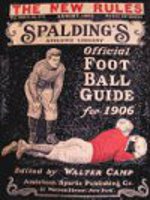
This summer, I began reprinting Spalding’s Football guides for the years relevant to the Carlisle Indian School football program through Tuxedo Press. Carlisle played intercollegiate football from 1893 to 1917 (a 1918 schedule was arranged but never played due to the closing of the school). These books contain a plethora of information useful to historians and rabid fans. Originals are expensive and fragile, factors which limit their utility. Inexpensive paperback reprints that can be abused are much more practical for non-collectors.

Reprinting these books has been more complicated than expected. When someone asked me if a particular book was the eastern or western edition, I couldn’t answer him. Not only didn’t I know, I couldn’t tell by looking at the book. Looking at other years’ editions didn’t help either. David DeLausses, administrator of cfbdatawarehouse.com, has a nearly complete collection of Spalding Football guides but didn’t know how to tell the eastern and western editions apart. He did know that Spalding started printing the two editions in 1906. Prior to that, Spalding published a single edition covering the entire country.

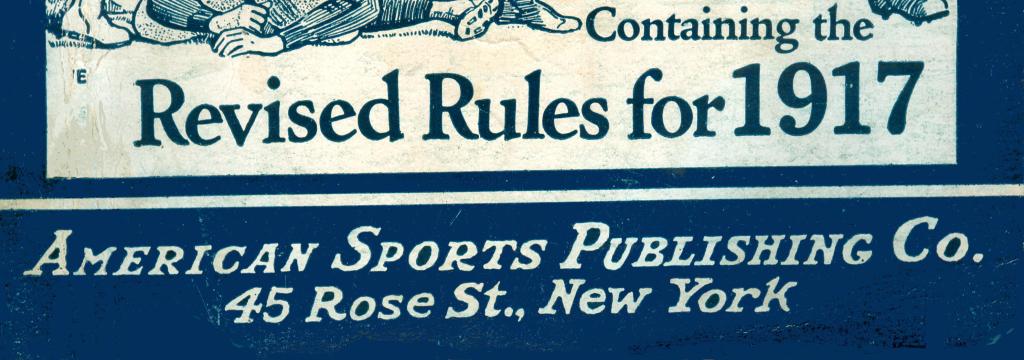
 I bought an original 1917 Spalding guide but couldn’t tell which edition it was and found no one who could. While preparing the 1917 book for publication, I noticed a small E on the front cover in a white block just below a drawing of players running a play (see below).


 Thinking the E might designate Eastern Edition, I emailed David DeLausses to get his opinion. As luck would have it, he was away from home on a business trip and, thus, couldn’t check against his copies. Upon his return, after looking at his guides, he responded,

“This is a great find.  From 1911-1918 Spalding Guides I can see either an “E” or a “W” on the front cover.  My 1917 Guide has a W.  I will be first in line to get a copy of your 1917 “E” version.  

I did not see similar markings for other years than 1911-1918.  I will have to spend some time looking closer.”

We still don’t know exactly what the differences in the two editions are, but comparing the two 1917 editions page by page should shed some light on this mystery.

Another Incubator of the Forward Pass

December 15, 2011

Periodically, one reads articles regarding the early development of the forward pass in football. It is now well known that Notre Dame did not invent the forward pass in their 1913 defeat of Army. It is also well known that Eddie Cochams, coach of the St. Louis University squad was an early implementer of the new strategy. Now, in a 1921 book, The Forward Pass in Football, written by Elmer Berry, Head Coach of Football and Baseball, Associate Director of Physical Education Department, Professor of Physiology and Physiology of Exercise at International Young Men’s Christian Association College, Springfield, Massachusetts, I hear of another proponent of the airborne pheroid.

It is doubtless fair to say that the early development of the forward pass was largely due to two teams, Springfield College of the Y. M. C. A. and the Carlisle Indians. Their game in 1912 at Springfield is said by competent experts to have been probably the greatest exhibition of open football ever staged. It is doubtful if two such finished exponents of the open game have ever met before or since. To Coach J. H. McCurdy of the Springfield team goes the honor, in the writer’s judgment, of the early recognition and development of the strategy of the forward pass, for in this respect at least, Springfield excelled even the wonderful Indian teams produced by Glen Warner. No one team can longer claim a leadership in this or any other department of the game, but it is fair to say that the Springfield team has continuously demonstrated an unusual aptitude for the forward pass and a high degree of leadership at least among the Eastern teams. It is not strange, in view of the fact that the great leaders of football have not taken more kindly to the forward pass, that its underlying principles have not been more thoroughly worked out and organized. It is the chief purpose of this work to state if possible some of these principles and fundamentals to the end that the open game of football, always in the past and still to some extent opposed by certain groups, may be better understood, more successfully coached and more firmly and thoroughly established.

Further research is required to determine how much salt to take with Berry’s claim.