Archive for the ‘Dickinson College’ Category

Indians Apply for Dickinson College Job

April 1, 2009

When looking through the Dickinson College archives for something else, the first paper I saw was a 1931 newspaper article announcing that Jim Thorpe had applied for the vacant head football coach position at that institution. Thorpe only wanted to coach there for a year because he was involved in business matters in the Oklahoma oil industry that were expected to occupy more of his time in the future. He was also negotiating with Mississippi A&M. Dickinson alum Gus Welch also applied for the position as did 50 others.

Neither of the Indians got the job as it was formally accepted by Joseph M. McCormick at the “D” banquet held on March 25th at the Molly Pitcher hotel. McCormick had been coaching at prep schools such as Mercersburg Academy and The Hill School. He had most recently coached at Roxbury School in Cheshire, CT. He led Dickinson’s Red Devils to their best season in six years. Thorpe took a job digging the foundation for a new hospital in Los Angeles. There was some truth to Thorpe’s story about the oil business, but it was in East Hawthorne, CA. The Jim Thorpe Petroleum Syndicate acquired 100 acres of land formerly owned by Gilbert Bessemyer. Jim was president of the syndicate and his cousin, Hawthorne’s chief of police, was one of the directors. In late April, the Putnam City school district announced that Thorpe had been hired as director of athletics for the rural school district located five miles west of Oklahoma City. In late June, he went into the movies to play, not surprisingly, Indian parts. He had small roles in a number of films. He spent New Year’s Day of 1932 watching the Rose Bowl, is first, as an Associate Press reporter.

Gus Welch became the head coach at Haskell Institute in 1933 after Lone Star Dietz departed for the NFL.
Final Remarks on Cayou’s Abduction

November 17, 2008

The January 28, 1898 issue of The Indian Helper had something to say about the incident:


“Our Mr. Frank Cayou, ’96, has passed through some College Freshman trials this week.  On Tuesday night the Dickinson College Freshman held a class banquet.  On Sunday night as Mr. Cayou was coming from church with two of our ladies he was spirited away by the Sophomores.  A crowd of them was standing around the church door as the three came out.


“Before they knew it the ladies were left without escort, and were obliged to come out from town alone.  Not a ‘Soph’ offered to come with them.  It is said that Cayou fought like a lion for the honor of his class, but ten or a dozen Sophomores were too much for him.  They placed him in a buggy and drove him toward the mountains, and at this writing, Wednesday morning, he has not appeared.  The Sophomores tried to steal several more of the Freshmen so as to break up the banquet, but did not succeed.  Such things are so ‘funny’ that the Man-on-the-band-stand can scarcely write about them.  He would like someday to have a new kind of a joke to laugh at if the bright young college gentlemen could only THINK of something not quite so stale.


  LATER:  Mr. Cayou has returned and tells a story of good treatment at the hands of the Sophomores.  His time was spent in the North Mountain, at Sterretts Gap Hotel, and at various other places.  Some of the time he was tied to a Sophomore so as to prevent the slightest chance for escape.  The Sophomores did not get the prize they thought they had, for Mr. Cayou was not toastmaster, as they surmised and had no part in the banquet program, and he was the only one absent.  There is considerable excitement among the college men at this writing and a strong class feeling exists.  All sorts of rumors are afloat as to what is to be done by those in authority, but we have nothing definite.”

The 1900 Microcosm included Dickinson College students’ takes on the affair in the Daily Chronicle section:

November 27th

Cayou goes to church alone.

Miss Beitzel goes to church alone.

January 14th

Cayou absent from chapel.

Miss Beitzel absent from chapel.

January 23rd

Docky warns Sophs to return Cayou.

(Apparently Docky was students’ pet name for President Rev. George Edward Reed)

Blanche Una Beitzel was listed as a Junior, a member of the class of 1900, with the motto:

‘Tis not that I love Dickinson less, but the Indian School more.

The football team photo on page 146 lists F. M. Cayou, but the player looks exactly like Ed Rogers. Cayou and Rogers were enrolled in Dickinson College proper and the law school, respectively at that time. Both played for Dickinson against Penn State in the Thanksgiving Day game held after the Indian School’s season ended.

One can only wonder how such a kidnapping would be viewed in 2008.

The Kidnapping of Frank Cayou – Part II

November 13, 2008

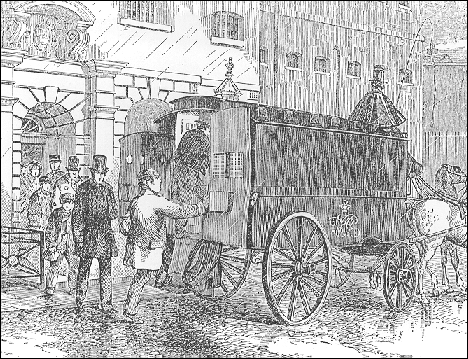
Decades later Parson Decker, freshman president of the class of 1902, recalled that a “council of war” was convened after which a bus pulled by a team of four horses was engaged to search for and retrieve their captured classmate. Around midnight the bus loaded with a dozen or so men from the class set out for Boiling Springs and Mt. Holly Springs in near-zero-degree weather. Dispirited, they returned to Carlisle around dawn Monday and assembled at The Wellington Hotel, the site of the next day’s class banquet.

During the day various information and misinformation traveled through the grapevine that Cayou and his captors were holed up in the Mountain House atop Sterretts Gap on North Mountain. Armed with the search warrant, the “rangy and rugged classmen” and the bus headed up Sterretts Gap late that afternoon. Halfway up the mountain, the bus stopped, the occupants got out, and went to their appointed posts encircling the hill. At the signal they started moving upwards, tightening the noose on the abductors. The plan was executed perfectly and, once all the men were at the top, the process-server served the warrant on the innkeeper who informed them of their errors. First, he said that warrants could only be served in the daytime and, second, this was a Cumberland County warrant and the Mission House was located in Perry County.

Regrouping after their hopes were dashed a contingent headed off to Summerdale to acquire a proper warrant. Using the second floor of a nearby corncrib as a barracks, those left guarding the hotel rested after setting up a watch schedule. Sleet began to fall, but the guards made their appointed rounds using only blankets taken from the bus as cover.

The next morning the correct search warrant was served but nothing was found. A search of the premises revealed nothing because Cayou’s captors got wind of the expedition the previous night and hustled him down the mountainside where they took refuge in a woodman’s hut.

As the dejected men of the class of ’02 went down the hill their bus met another “black maria” heading up. Some men of ’02 grabbed the harnesses of the horses pulling ‘01’s bus up the hill. Others pulled Chambers and Odgers, classmates who had been kidnapped that morning, out of that bus and put them into that of their own class. Feeling a little less disappointed with the success of their mission, the posse returned to The Wellington where the entire class, less Cayou, stayed incommunicado the rest of the day to reduce further losses.

The banquet was held as scheduled, sans Cayou who was returned the next morning.

Next time The Indian Helper’s take on Cayou’s abduction

Black Maria

Black Maria

Indian School movies

June 27, 2008

Carlisle Indian School has been of interest to Hollywood since the movie industry’s earliest days. In 1901, American Mutoscope and Biograph shot a documentary short at the school. Footage included both male and female students swinging clubs. Still photos of this type of exercise can often be found on ebay. Also included in the documentary were a military-style parade of the students including the renowned school band, girls doing a dumbbell drill, boys demonstrating gymnastics events, boys playing a basketball game, and members of the track team high jumping and pole vaulting. No, Jim Thorpe was not filmed because he was not at Carlisle at that time.

In 1913, Selig Polyscope filmed The Tie of the Blood at the school. Little is known about the film other than its main cast members. In 1915 Pathe Weekly filmed the installation of the first Indian Boy Scouts of America troop at the school. Also participating in the parade, exhibitions and ceremonies were local boy scouts and the Indian School’s Campfire Girls. And other films that I do not know about may have been filmed at the school.

Several alumni worked in motion pictures as actors, stuntmen and in other capacities. Lone Star Dietz even invested in the Washington Motion Picture Company and lost his investment. Jim Thorpe not only worked in pictures but had his life story told on film in the 1951 Warner Brothers release, Jim Thorpe – All-American. Interest in putting the Indian school on film waned but in recent years has grown.

In April 2002, Variety Film reported, “Fox 2000 has snapped up a pitch by Craig Sherman and Bob Jury on legendary football coach Glenn S. “Pop” Warner and his first season at the Carlisle Indian School.” In April 2004, Walden Media announced that John Sayles would be bringing Carlisle School to the big screen. In 2005 Steven Spielberg brought Carlisle Indian School to the little screen as part of his Into the West miniseries. And there’s more, so much more interest that Freddie Wardecker has lost count of how many filmmakers have come into his store to look at artifacts. Barb Landis at the Cumberland County Historical Society thinks that she gets at least a call a month from someone interested in doing a movie about the school or Pop Warner or Jim Thorpe or … I even ran into one of them in the Dickinson College archives last year.

The problem is that a historically-accurate film needs to be made but, despite all the talk, no one has stepped up to make it. Do you have any ideas?

Steckbeck Collection Donated

June 12, 2008

Yesterday’s Sentinel contained an article of interest to those interested in the Carlisle Indian School and related topics: http://www.cumberlink.com/articles/2008/06/11/news/local/doc484fd5b21a214085579032.txt

Janet Zettlemoyer and Ilene Whitacre, daughters of John S. Steckbeck, donated their late father’s Carlisle collection to Cumberland County Historical Society. Steckbeck wrote Fabulous Redmen: the Carlisle Indians and their famous football teams in 1951 but the collection that fills 16 copier paper boxes is not limited to Carlisle football items. I’m told that it isn’t limited to Indian School-related items, that it contains a few things of interest to Carlisle (the town) history. However, there is so much stuff to sort through and catalog that it will be some time before collection items are made available to the public.

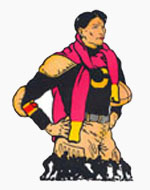
Photographs accompanying the newspaper article include parts of an oil painting and a pen and ink drawing that looks familiar. Discussions with my sources revealed that the oil painting was done by Frank Maze, Dickinson College head football coach 1950-51. It is based on the famous graphic done by Lone Star Dietz that is used as the frontispiece for Steckbeck’s book and on the masthead of this blog. However, Maze put a different head on his version. But whose head was it?

The pen and ink drawing – there turned out to be three in the collection – are Dietz originals of the artwork that adorned the cover of The Red Man magazine. Apparently the collection includes several Dietz items that Steckbeck purchase from the old warrior after he fell on hard times. I can’t wait to see this stuff.

Jim Thorpe historians will not be disappointed as the collection includes an audiotape of Steckbeck’s interview of Thorpe. I hope excerpts from this find their way into the audiobook version of Bob Wheeler’s landmark biography of Thorpe.

The collection also includes glass photo negatives of portraits of Indian School students. Who knows what else might be found in that collection?

Galleys Received

May 27, 2008

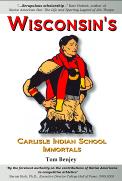
The advance reading copies (called ARCs in the trade) arrived for my new book and are being sent out to reviewers. This is a big moment in a writer’s life: seeing thousands of hours of hard work turned into something tangible. In the old days (pre-computer), ARCs were called galleys, bound galleys or galley proofs. Authors, editors and publishers go over these babies with a fine-tooth comb looking for errors, typos or things that have changed since writing was complete. It is an impossible task because, after all this scrutiny, some typos escape and find their way into the final book. But we try.

Another important use of ARCs is to see how the photos and artwork come out in print. Overall they came out very well, better than expected. But a cartoon about the Oorang Indians from a 1922 Baltimore newspaper is too dim. The challenge now is to figure out how to darken it without losing the detail.

This weekend I received some additional information and a correction regarding Louis Island from a family member who happened to see a previous blog. That was fortuitous because I want the book to be as accurate as possible. This blog is already proving to be of some value. That encourages me to continue with it.

Having these ARCs provides local booksellers the opportunity to provide their customers something extra. People can look at an ARC and pre-order the book if they choose. The bonus, besides being sure of getting a copy of the book as soon as it comes out, is to receive an inscription of his or her choice signed by the author. On-line booksellers also take pre-orders but personalized inscriptions are impractical.


The Great Crockery Riot

March 24, 2008

While researching Carlisle Indian School students who enrolled at Dickinson College, I stumbled across a small item that was put on the wire and printed across the country in late May of 1912:

CARLISLE, Pa. –Dickinson College students stoned the house of the dean because they thought the annual per capita tax of $1.95 for “breakage” was too high.

Being easily distracted, this curious item aroused my interest and I did a little research. It seems that in those days crockery breakage was significant. It is not known if students were merely clumsy or had hurled cups, saucers, plates or soup bowls at one another on purpose. Regardless, the total cost of replacing the smashed crockery was substantial. So, near the end of the school year, the total amount of this breakage was computed and divided by the number of male students enrolled at the college. Each young man’s share generally amounted to about $2. Why 1912’s assessment triggered such a response is not known. I don’t think this was an early blow for equal rights for women, so we need to look into other possibilities. Because the assessed amount was lower than it had been in some previous years, the cost of the assessment probably wasn’t the match that set off this tinderbox. A Dickinson professor asked if this happened during President Reed’s time. A quick reference to the records showed that Dr. Reed had retired and his successor, Dr. Eugene Allen Noble, was ensconced in the President’s house but had not been inaugurated. That event was scheduled just days after the stoning. Perhaps the students were misunderstood and were merely welcoming Dr. Noble to the campus. Or, they may have been hazing him as part of the inauguration festivities.

We will not likely ever know what was the cause. However, it is known that Dickinsonians were sensitive to the condition of their crockery. Some years earlier, a German professor at Dickinson College’s preparatory school became so agitated after being served his dinner on cracked crockery that it took three large boys to restrain him in his anger.