Archive for the ‘Charles Guyon’ Category
August 28, 2008
One of the most difficult and time-consuming things my editor has me do is to provide players’ full names. Now James G. Sweeney, a lawyer from Goshen, New York and a 50-year West Point supporter, has requested that I help him identify a number of players. Sweeney is writing an article about the 1905 Carlisle-Army game that was approved by the War Department but can’t find players’ first names in newspaper reports. Apparently because I write about Carlisle Indian School football, he thought I’d know all the players’ names. I wish it were so.
Finding the biggest stars’ first names isn’t too difficult and, by now, I can give most of them off the top of my head, assuming that I don’t have a senior moment. Even identifying them wasn’t a piece of cake. One of the reasons for that was that some of them played under multiple names. For example, Emil Hauser was better known as Wauseka and his brother, Pete, was also a star player; Charles Guyon went by Wahoo and, to confuse things further, his younger brother, Joe, came along a few years later and made an even bigger name for himself; and William H. Dietz played as Lone Star. Linda Witmer’s The Indian Industrial School: Carlisle, Pennsylvania 1879-1918 includes a list of students that attended Carlisle. Although incomplete, it nonetheless is a useful tool. One of the problems in identifying players is that many siblings and cousins attended the school. Determining which one is the correct person is a challenge.
Carlisle Indian School publications are invaluable resources. In 1905 the school newspaper went by The Arrow. The school had no literary magazine at that time. Most of the big games were covered by The Arrow. Often articles from big-city papers were reprinted in it. From them we get our cast of characters, if only by their last names. Varsity football players were often active in the literary and debating societies because they were among the oldest on campus. Write ups of these societies’ activities often included full names. Football stars often got press for more mundane activities because they were famous. These pieces often included their first names. Players other than stars received less coverage.
Graduation coverage included full names for the graduating class and much coverage of the individuals in that class. Because most students had little proper schooling before coming to Carlisle and often at advanced ages, they were unwilling or unable to commit to lengthy courses of study that would lead to graduation.
My ace in the hole is the athletic or football (it varied) banquet. This time I hit pay dirt because the coverage of the 1905 football banquet (held in early 1906) included not only the menu for the banquet and the toasts given, but a complete roster of the players on the team with those who lettered identified with Xs. Well not exactly complete. Chauncey Archiquette’s name was omitted. Perhaps Jeffrey Powers-Beck has the reason for his omission from the list in Chief: The American Indian Integration of Baseball, 1897-1945 when he states that Archiquette, then 28, was an 1898 Carlisle grad who had played football and other sports during his days at the school and returned as staff in 1905 but played again. This was the same Archiquette a 1953 Los Angeles Mirror article claimed was Jim Thorpe’s boyhood idol.

Tags:1905 Carlisle Army game, Carlisle vs. Army, Chauncey Archiquette, James G. Sweeney, Jeffrey Powers-Beck, Linda Witmer, The Real All-Americans, Wahoo
Posted in Carlisle Indian School, Charles Guyon, Emil Hauser, Football, Jim Thorpe, Joe Guyon, Lone Star Dietz, Pete Hauser, Wauseka | 2 Comments »
August 21, 2008
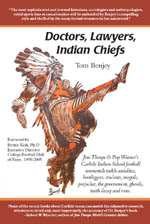
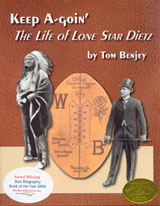
With the release of a new book starts another adventure – radio interviews. The first one I’m doing for Doctors, Lawyers, Indian Chiefs is with Warner Lewis on his Lewis at Large Smart Talk Radio show out of Lawrence, Kansas. The interview is being taped and will be aired the week of August 25 to 31 on KLWN Lawrence, KFRM Clay Center, KLKC Parsons and possibly other stations in eastern Kansas. Warner interviewed me two years ago on his sports talk show after Keep A-goin’: the life of Lone Star Dietz was released. It was a great experience. There are strong ties between Carlisle, PA and Lawrence, KS beside the fact that Lone Star Dietz played for Carlisle Indian School and coached Haskell Institute (now Haskell Indian Nations University) in Lawrence. When athletics were deemphasized at Carlisle, the leadership mantle was passed to Haskell where, during the 1920s and very early 1930s, the Fightin’ Indians were, as Ray Schmidt described, the lords of the prairie.
But more than the mantle passed from Carlisle to Haskell. Students also transferred to Haskell as well, Nick Lassaw for one. Nick was perhaps better known by the moniker given to him when he played for the Oorang Indians: Long Time Sleep. However, transferring between the two government Indian schools did not start at that time; it had a long tradition. The most notable example was after the 1904 Carlisle-Haskell game held at the St. Louis World’s Fair, the only time the schools played each other, when eight football players including the Guyon and Hauser brothers and several others came east to play for the stronger team.
There are other reasons that make Lawrence an appropriate to kick off my radio tour. Bernie Kish, Executive Director of the College Football Hall of Fame, 1995-2005, now lives in Lawrence. Bernie wrote a forward for Doctors, Lawyers, Indian Chiefs and I’m waiting for him to write a history of Haskell.
Tags:Bernie Kish, Haskell Indian Nations University, Haskell Institute, KLWN, Lawrence Kansas, Lewis at Large, Ray Schmidt, Smart Talk Radio, Warner Lewis
Posted in Carlisle Indian School, Charles Guyon, Doctors, Lawyers, Indian Chiefs, Football, Joe Guyon, Lone Star Dietz, Nick Lassa, Pete Hauser, Wauseka | Leave a Comment »
July 21, 2008
The 1904 Olympics were not the first games to feature football. The 1900 Paris games included two football events neither of which were American football. Soccer and rugby were both played that year but in 1904 American football appeared in the Olympics for the first time. Football (soccer) was a demonstration sport in which three teams played a round-robin tournament between two American teams and a Canadian club. The Canadians won the gold. Several college football games were played on Francis Field at the fair. Washington University and St. Louis University each played a number of their games on the Olympic field. Missouri and Purdue even played there. Prior to the Fair, Washington U’s teams were known as the Purities but due to playing at the Fair were renamed the Pikers in 1905 as a comment on their association with the infamous world fair’s Pike. However, the most important college football game played at the 1904 Olympics wasn’t played by colleges.
President Theodore Roosevelt was to visit the Fair over Thanksgiving weekend making it an ideal time for a major football event (read moneymaker). The Fair organizers’ first choice was to have West Point and Annapolis relocate their annual contest to the fairgrounds but that didn’t happen. Haskell Institute’s Fightin’ Indians were tearing up the Midwest at that time and Carlisle was a top ten program. So, the first ever football game between the two government Indian schools was arranged for the Saturday after Thanksgiving. Carlisle already had a Thanksgiving Day game scheduled against Ohio State in Columbus. Major Mercer, the new Carlisle superintendent, very likely saw the opportunities such a high profile game would create for him and his school and added the game to the schedule. Playing two games in three days may have been taxing for Carlisle’s players, so Head Coach Ed Rogers (Pop Warner was back at Cornell for the 1904-6 seasons) drubbed the Buckeyes with his second team 23-0. Ohio State supporters were unhappy to miss seeing the Carlisle stars they had read so much about.
Rumors of Haskell bringing in ringers, some of them white, were rampant. To balance the scales, Ed Rogers suited up for the game as did Assistant Coach Bemus Pierce and his brother, another former Carlisle and pro star, Hawley Pierce. They needn’t have bothered. Carlisle obliterated Haskell 38 to 4. Seeing the superiority of the Carlisle program, eight Haskell players transferred to the eastern school where many became stars. If there was an Olympic gold medal to have been won Carlisle would have won it, but none was. However, the Carlisle Indians were the closest thing to an Olympic football champion that we’ve had – if you ignore the 1920 and 1924 U.S. rugby teams. But that’s a story for another time.
The Native American game of lacrosse was played at the 1904 Olympics but mostly by non-natives. Three teams, two from Canada and one from the U.S., vied for the championship. The Canadian Shamrocks won the gold, the St. Louis Amateur Athletic Association won silver, and, in a bit of irony, the Mohawk Indians from Canada got the bronze.
Next time we take a look at the 1908 games.
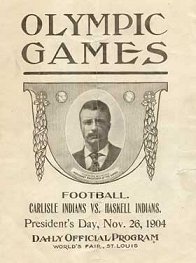
1904 Carlisle-Haskell game program cover
Tags:1904 Olympics, Haskell Institute, lacrosse, St. Louis World's Fair, Theodore Roosevelt
Posted in Albert Exendine, Carlisle Indian School, Charles Guyon, Ed Rogers, Emil Hauser, Football, Frank Mt. Pleasant, Hawley Pierce, Joe Guyon, Wauseka | Leave a Comment »
May 27, 2008
The advance reading copies (called ARCs in the trade) arrived for my new book and are being sent out to reviewers. This is a big moment in a writer’s life: seeing thousands of hours of hard work turned into something tangible. In the old days (pre-computer), ARCs were called galleys, bound galleys or galley proofs. Authors, editors and publishers go over these babies with a fine-tooth comb looking for errors, typos or things that have changed since writing was complete. It is an impossible task because, after all this scrutiny, some typos escape and find their way into the final book. But we try.
Another important use of ARCs is to see how the photos and artwork come out in print. Overall they came out very well, better than expected. But a cartoon about the Oorang Indians from a 1922 Baltimore newspaper is too dim. The challenge now is to figure out how to darken it without losing the detail.
This weekend I received some additional information and a correction regarding Louis Island from a family member who happened to see a previous blog. That was fortuitous because I want the book to be as accurate as possible. This blog is already proving to be of some value. That encourages me to continue with it.
Having these ARCs provides local booksellers the opportunity to provide their customers something extra. People can look at an ARC and pre-order the book if they choose. The bonus, besides being sure of getting a copy of the book as soon as it comes out, is to receive an inscription of his or her choice signed by the author. On-line booksellers also take pre-orders but personalized inscriptions are impractical.

Tags:Add new tag, ARC, biography, book, galleys, Louis Island
Posted in Albert Exendine, Alex Arcasa, Antonio Lubo, Archie Libby, Arthur Sheldon, Bemus Pierce, Benjamin Caswell, Caleb Sickles, Carlisle Indian School, Charles Guyon, Charles Williams, Dickinson College, Doctors, Lawyers, Indian Chiefs, Ed Rogers, Elmer Busch, Emil Hauser, Football, Frank Cayou, Frank Hudson, Frank Mt. Pleasant, Fred Broker, George May, George Tibbits, George Vedernack, Gus Welch, Hawley Pierce, Henry Broker, Hugh Wheelock, Isaac Seneca, James Johnson, James Phillips, Jim Thorpe, Joe Bergie, Joe Guyon, Joe Libby, Joel Wheelock, John B. Flinchum, Leon Boutwell, Lone Star Dietz, Louis Island, Martin Wheelock, Nicholas Bowen, Nick Lassa, Pete Calac, Pete Hauser, Pop Warner, Sampson Bird, Single-Wing, Stacy Matlock, Stancil Powell, Thomas St. Germain, Victor Kelly, Washington Redskins, Washington State University, Wauseka, William Baine, William Gardner, William Garlow, William Newashe | Leave a Comment »


 Tom Benjey's Weblog
