Archive for the ‘Carlisle Indian School’ Category

Honest lunatic

April 21, 2008

The May 18, 1905 edition of the Carlisle Indian School newspaper, The Arrow, listed the then current enrollments at over a dozen of the largest colleges and universities in the country at that time. Several of these large schools were and still are private schools whose enrollments haven’t grown anything like the state schools on the list. Perhaps the growth or lack thereof of student bodies gives us some insight as to why some of these schools are no longer football powers like they once were. It should give us a sense of what portion of the population went to college a hundred years ago – a very small portion. College students then consisted primarily of scions of wealthy families. Athletic scholarships didn’t exist then, at least officially. However, great athletes found their way into the elite schools and onto their teams, even if not always enrolled.


When Carlisle started playing football against the elite schools, including The Big Four, pundits were surprised to see the Indians play so well with so little formal training. They were not thought to be smart enough to play this game that originated at the major colleges and universities. Nor were they thought smart enough to compete successfully. Carlisle’s success on the gridiron showed the larger population that they could compete on a level playing field. If Indians could master something as difficult as football, they could surely become competent in other things. Critics viewed Richard Henry Pratt, founder of the school, as an “honest lunatic” because they thought Indians were not educable. The football team’s foes soon learned otherwise and, by the very early 20th century, some Carlisle alums were attending major colleges or universities and others were coaching high school or small college football teams. Not educable? Huh!


Bob Wheeler’s Return

April 17, 2008

This week Jim Thorpe’s biographer returned to Carlisle to pick up his new suit. Mose Blumenthal was a tailor at the Carlisle Indian School and also outfitted students in civilian clothes at his haberdashery, The Capital.  Today that store is operated by Freddie Wardecker and sports Indian School memorabilia on its walls. My hope was that in the basement or attic Freddie would find a suit of the style worn by Jim Thorpe for Bob. But that wasn’t to be.  Bob had to settle for a dark business suit that is appropriate for almost any occasion. He topped it off with a Lone Star Dietz signature tie that is perfect for wearing at book talks. It should also be a hit in his home state of Texas. Although photos were taken they can’t be posted because they turned out too dark, probably due to photographer error.

While in town Bob and Florence visited several sites related to Jim Thorpe. Their first stop was Carlisle Barracks to see the former Indian School buildings and, of course, Indian Field. It was too late in the day for taking photographs so Bob returned the next day before leaving town. Prior to visiting the graveyard we mistakenly thought the graves were all of students who died while attending the school. However, we noticed that a couple of rows of the graves appeared to be for soldiers who had been stationed at Carlisle Barracks. Surprisingly, some of the dates on a few of the tombstones were relatively recent, after the Indian School had closed. Sadly, most of the grave markers contained little information about the person. Having more information would helpful. For instance, one marker only provides the name, Paul Wheelock. From researching a cousin who played football and was a pallbearer for Paul, I know that he was the infant son of Bandmaster Dennison Wheelock. Did the baby’s death cause the father to leave Carlisle or was it coincidental with another opportunity arising? The shortage of information makes it difficult to answer that question.

Bob and Florence also visited Whistlestop Bookshop and Cumberland County Historical Society. It would be great if we could get Bob, Flo and our local folks to coordinate a talk the next time they are in town. I, for one, hope we don’t have to wait until next tennis season.

Thorpe played basketball too

April 13, 2008

In March 2005 Anthony Barone, Jr. found a ticket in a book he had purchased for $6.00 at an auction. What is remarkable about this unusual event is that a ticket to a March 1, 1927 basketball game involving Jim Thorpe and his World Famous Indians dropped out of the book. Big Jim’s involvement in March Madness is not much known about today although it was covered in newspapers of the day.

When Jim first started playing basketball is not known. The first known documentation of his playing on the Freshman Class and Carlisle Indian School varsity teams in January 1909. So, Jim played hoops competitively long before the ticket date. If he played competitively after the 1909 season is not known either. However, he definitely played in 1927.

That he had formed the World Famous Indians or Oorang Indians, as they were sometimes referred to, was widely reported in November 1926. Also reported were the names of his teammates:

  • Raymond West, “Light Foot,” Cheyenne, forward
  • Dennis Hildebrand, “Eagle Feather,” Cherokee, guard probably
  • Leo Wapp, “Running Hawk,” Sac and Fox, guard
  • Jess Parton, “Swift Deer,” Delaware, forward
  • Dale Peters, college player from Indiana, center
  • Fred Cooke, college player from Indiana, guard

Although the team was advertised as being an Indian team, the closest two of the team’s stars got to being Indians was to have lived in Indiana. The WFI played a heavy schedule of games in the Midwest and east. At 39, Jim was nearing the end of his competitive athletic career so didn’t play full games as he had when he was young. A quarter of intense exercise on the court was enough for him. As of March 31, 1927 Jim Thorpe’s hoopsters were 42-14 with the season not yet finished and baseball just around the corner. Instead of barnstorming with an all-Indian team that summer, Jim played baseball with a team of college players he and Ohio State University star Chic Harley put together.

Jim Thorpe’s Gloves

April 7, 2008

A mystery has haunted me since shortly after starting to research Lone Star Dietz’s life. Today, with the help of Freddie Wardecker, proprietor of Wardecker’s Mens Wear and Jim Thorpe Museum, and Bob Wheeler, Jim Thorpe’s biographer who, along with his wife Florence Ridlon, succeeded in getting Thorpe’s Olympic medals restored, I solved that mystery.

Lone Star Dietz died in 1964 and his wife, Doris, died three years later. Mary Lou Zientek had befriended the Dietzes and served as executrix of Doris’s estate. The estate consisted mostly of Lone Star’s memorabilia that included promotional photos for his movies and a pair of Jim Thorpe’s gloves. Mrs. Zientek donated many of the items from the Dietz estate to a museum in Pittsburgh. I was unsuccessful in locating any of these items in any museum in Pittsburgh. Today that changed.

Freddie Wardecker told me of a museum in Boca Raton, Florida owned by a man named Joel Platt. It seems that Mr. Platt wanted to build his museum just outside Carlisle some years ago but was turned down, so looked elsewhere. Last week Bob Wheeler mentioned Joel Platt in another context stating that he was from Pittsburgh. Today the light came on for me after Freddie chided me for not being able to locate Platt’s museum on the internet. Following his directions, the web site for Platt’s museum immediately popped up. After a little navigation, Jim Thorpe’s page appeared: http://www.sportsimmortals.com/thumb.cfm?ID=133&category=11&startrow=9

One item jumped out at me. I could never understand why Lone Star had a pair of Jim Thorpe’s gloves or why he would have kept them so long because I thought they were just ordinary men’s gloves. Well, these are not ordinary gloves. Seeing them will explain everything.

The photo shows other items related to Jim Thorpe’s time in Carlisle. Now that the Cumberland County Historical Society has funds for acquiring artifacts, perhaps they can bring Jim Thorpe’s jersey, letter sweater, gloves and other items back to where they belong.

Minority Coaches

March 28, 2008

Yesterday I came across a December 8, 2007 article in The News Tribune out of Tacoma, Washington. In it reporter Todd Miles wrote, “Not since 1917 have the Washington State Cougars had a minority head coach in football.” Putting aside the fact that Washington State’s teams weren’t called the Cougars in 1917, the statement is still incorrect. Yes, Lone Star Dietz coached the 1918 Mare Island Marine team that was featured in WSC’s yearbook because ten players were from WSC. And, although Dietz considered it Washington State’s second Rose Bowl team, it didn’t wear crimson and gray. The major error is that not one but two minority coaches were overlooked. This is why we study history.

When Dietz was unceremoniously dumped in early 1919, WSC wanted another coach who was steeped in the Warner system because Dietz had been wildly successful with it. So, the administration looked for someone with experience, not just with the single and double-wing formations but with the whole system. Recall that Ace Clark thought that the way Lone Star conditioned his players and reduced the amount of scrimmaging left them in better shape for the games. Albert Exendine was a logical choice but he was under contract at Georgetown. Eventually Gus Welch was tracked down on a former battlefield in France and recruited for the job.

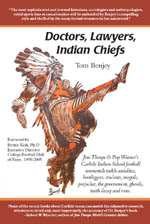
Gus Welch was Chippewa from Wisconsin and Al Exendine was Delaware and Cherokee from Oklahoma, but they have a lot of similarities. Both attended Carlisle Indian School and starred on its teams, Exendine at end and Welch at quarterback (blocking back in Warner’s single-wing). Both got their law degrees from Dickinson School of Law (now part of Penn State) across town from the Indian school. Both had long careers of coaching football in the fall and practicing law the rest of the year. Both were inducted into the College Football Hall of Fame as players. And both coached Washington State. Welch led the team from 1919 through 1922 and Exendine took over in 1923, lasting through the 1925 season. Each has a chapter devoted to him in Doctors, Lawyers, Indian Chiefs.

So, Washington State has a history of hiring minority head football coaches, just not lately.

The Great Crockery Riot

March 24, 2008

While researching Carlisle Indian School students who enrolled at Dickinson College, I stumbled across a small item that was put on the wire and printed across the country in late May of 1912:

CARLISLE, Pa. –Dickinson College students stoned the house of the dean because they thought the annual per capita tax of $1.95 for “breakage” was too high.

Being easily distracted, this curious item aroused my interest and I did a little research. It seems that in those days crockery breakage was significant. It is not known if students were merely clumsy or had hurled cups, saucers, plates or soup bowls at one another on purpose. Regardless, the total cost of replacing the smashed crockery was substantial. So, near the end of the school year, the total amount of this breakage was computed and divided by the number of male students enrolled at the college. Each young man’s share generally amounted to about $2. Why 1912’s assessment triggered such a response is not known. I don’t think this was an early blow for equal rights for women, so we need to look into other possibilities. Because the assessed amount was lower than it had been in some previous years, the cost of the assessment probably wasn’t the match that set off this tinderbox. A Dickinson professor asked if this happened during President Reed’s time. A quick reference to the records showed that Dr. Reed had retired and his successor, Dr. Eugene Allen Noble, was ensconced in the President’s house but had not been inaugurated. That event was scheduled just days after the stoning. Perhaps the students were misunderstood and were merely welcoming Dr. Noble to the campus. Or, they may have been hazing him as part of the inauguration festivities.

We will not likely ever know what was the cause. However, it is known that Dickinsonians were sensitive to the condition of their crockery. Some years earlier, a German professor at Dickinson College’s preparatory school became so agitated after being served his dinner on cracked crockery that it took three large boys to restrain him in his anger.

Celebrity visitors

March 21, 2008

Carlisle had two celebrity visitors yesterday. Robert W. Wheeler and his wife, Florence Ridlon, dropped in at Wardecker’s Mens Wear to buy Bob a suit. Some might think it odd for a person who lives in Sandy Shores, Texas to drive to Carlisle on such an errand. However, it was a return trip for Bob, although close to 40 years in the making. What began as a master’s degree thesis in the late 1960s became a seven-year odyssey to research the life of America’s greatest athlete, Jim Thorpe. Bob’s research was not supported by a foundation grant and, as a graduate student at Syracuse University, he had few personal financial resources and found it necessary to travel across the country by hitchhiking. After he arrived at “The Capital,” as the haberdashery was known when Thorpe patronized it, “Muck” Wardecker dispatched his son, Freddie, the current owner, to chauffeur Bob around the area to interview Thorpe’s old friends. This time Bob and Florence drove themselves to Carlisle.

Much has happened in the intervening decades. For starters, Bob’s master’s thesis became the book, Jim Thorpe: world’s greatest athlete. However, getting college credit for writing the book was not automatic. That is a story best left to Bob to tell. After publication, the book got rave reviews. Dick Schaap compared Wheeler to James Boswell, the author of what has been considered the best biography ever written for any person. Bob got married but his interest in Thorpe did not wane. In fact, his bride, Florence Ridlon, became involved with the effort. One day in a musty archive, Florence found something that would have a major impact on the sports world.

She found the rules for the 1912 Olympics. In those rules she saw that challenges had to be filed within 30 days of the Olympics. The challenge that caused Thorpe to be stripped of his medals was filed almost six months after the Olympics and should not have been allowed. Getting Thorpe’s medals restored was not a simple matter and that story is best left for Bob and Florence to tell, also. Suffice to say that we will always be indebted to them for what they accomplished – and it wasn’t easy.

After having a son in 1989, Bob decided to quit his glamorous job with ABC Sports and work with Florence in their public relations business based out of Texas so that he could be involved in the rearing of his child. Their son is now a tennis star at MIT and they are on the road to watch him play some matches in the northeast.

Bob is making an audiobook with Frank Gifford narrating. Interviews with people such as President Eisenhower will be included as what I would call making of material. I can’t wait for that to come out.

Also visiting with Bob and Florence was Carlisle’s own Dick Darr, who played at Syracuse alongside Florence’s brother, Jim Ridlon. Perhaps we can get an interview with Dick some day to discuss his competition for the tailback position with an upstart named Jim Brown.

It is hoped that Bob and Florence will honor Carlisle with a talk sometime in the future now that they have reason to pass this way again.

Welcome!

March 7, 2008

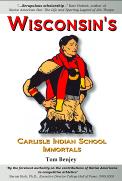
Welcome to my world. For most of the new century I have been researching the lives of Carlisle Indian School football stars, something that has been a very rewarding experience. Along the way we – my wife Ann assists in the research and sometimes finds some unexpected things – have met some interesting and very helpful people. We have also discovered things for which we can’t find places in the books but which people may find interesting. Let’s start with something recent.

In the summer of 2002, Ann and I took a tour of Tanzania with a group of 10 people. At night when we were all assembled for the first time, the guide subjected us to the dreaded circle routine. When it was my turn to introduce myself, I said that I was writing a book on Lone Star Dietz. A woman a couple of places away from me in the circle responded, “Do you mean Lone Star Dietz the football coach?” I responded in the affirmative and asked how she knew about him. The woman – Betty Tyler – informed me that, when she was a child the Dietzes lived next door to her in Reading, Pennsylvania, where he coached the Albright College football team at that time. I was shocked to meet someone who actually knew Dietz in a group of 10 people on the other side of the world.

Betty’s mother, Dorothy Hawkins, was living near Charleston, South Carolina at the time and, although in her 90s, had a very clear mind. That fall Ann and I visited some friends in Charleston – the ones who arranged the Africa trip – so I could interview Mrs. Hawkins. Dorothy was a lovely person and shared information about Lone Star that one cannot find in newspaper reports or public files. She was very helpful, especially because she and her family moved to Pittsburgh and kept in contact with the Dietzes who were also living there after the war. Through Betty and her mother I was also able to interview Betty’s brother. That interview was conducted over the phone because he lives in San Francisco. He recalled Lone Star parading up and down the street in his Sioux regalia and challenging the kids to tug on his pitch-black hair to show that it was all real.

Late last year we received some sad news: Dorothy Hawkins had died. In addition to the bad news, Betty Tyler gave us some good news. Betty’s mother had a painting Lone Star gave her many years ago and Betty didn’t have a place for it in her house. Knowing that I was so interested in Lone Star and would appreciate it, she gave it to me. What good fortune! Now I must reorganize my already cluttered office to give it an appropriate place on the wall.

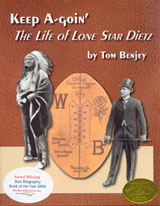
To learn more about Lone Star Dietz, check out www.LoneStarDietz.com. To learn more about my upcoming book, check out www.Tuxedo-Press.com. If you’re interested in seeing video previews for the books, look at www.YouTube.com/TomBenjey.

Now I must go to the Cumberland County Historical Society to look at the Jim Thorpe letters they just acquired. More on that later.