Archive for the ‘Carlisle Indian School’ Category

Snookered by Wauseka

February 26, 2009

I just found out that, like almost everyone else interested in the Carlisle Indian School, I had been snookered. The trickster is a major figure in American Indian lore and another one has been brought to my attention. I bought the idea that Wauseka was Emil Hauser’s Cheyenne name. Now I learn that he made it up as a joke.

Pete and Emil Hauser were friends of Mike Balenti as was Albert Exendine and they visited him in his home in Oklahoma after all left Carlisle. It was during one of these visits that the joke was shared and Balenti’s son heard it. It turns out that Emil Hauser made up the name on a lark and it stuck. Knowing this raises a lot of questions, the answers for which can only be speculated.

When and where he coined his name is not known, but something is known about a similar action taken by his old teammate Charles Guyon. When Guyon and Hauser were both attending, and playing football for, Haskell Institute, Guyon would play summer baseball in the Midwest. When interviewed by one-too-many a newspaper reporter who couldn’t pronounce his Chippewa name, Charlie gave him the name of the town in which he was playing at the time, Wahoo, Nebraska. When he played at Carlisle he went by both Wahoo and Charles Guyon. In later years he was often referred to as Charlie Wahoo or Chief Wahoo.

Emil Hauser may have taken a page from his old teammate’s book and appropriated a geographic name as his own. A quick search identified towns in Illinois and Wisconsin named Wauseka and a county in Minnesota named Waseca. The truth probably won’t ever be known but this is a plausible explanation, particularly because a friend of his had previously done something similar.

100th Post

February 23, 2009

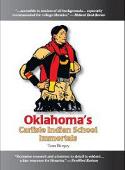
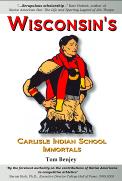
After posting the most recent message I noticed that it was the 100th one since the inception of the blog last March. That means that if you’ve read each and every message, you have read 30,000 words (100 messages X ~300 words each) in a little less than a year. On March 7th it will be a year. Something else just happened – minor brag alert – Doctors, Lawyers, Indian Chiefs was selected as a Finalist for the Reader Views 2008 Literary Awards in the Biography category. The most rewarding thing about blogging is that relatives of Carlisle Indian School students sometimes become aware that some information about their ancestors is available. For instance, last week someone asked about George Gardner, the brother of William Gardner. I didn’t have much on him but I was able to point the person to places that likely do have records and photos. Over the weekend I was looking for something in John S. Steckbeck’s Fabulous Redmen and opened the book to page 38. Opposite page 38 is a page full of player photos. In the upper right corner standing next to Wauseka is G. Gardner. That has to be George. I will tag this message with his name so that people searching for him stand a better chance of finding this. If you want to communicate with me privately, email me at Tom@Tuxedo-Press.com. I don’t post emails on the blog without prior permission. Sometimes I don’t post comments if they seem too personal in nature. This blog has helped some long-lost family members to get in touch with each other. That has been the most rewarding part of this endeavor. Now it’s back to working on my upcoming release, “Oklahoma’s Carlisle Indian School Immortals,” the first of a series that should be of interest to children as well as adults.

Carlisle Indian School Scrubs Beat Ohio State

February 19, 2009

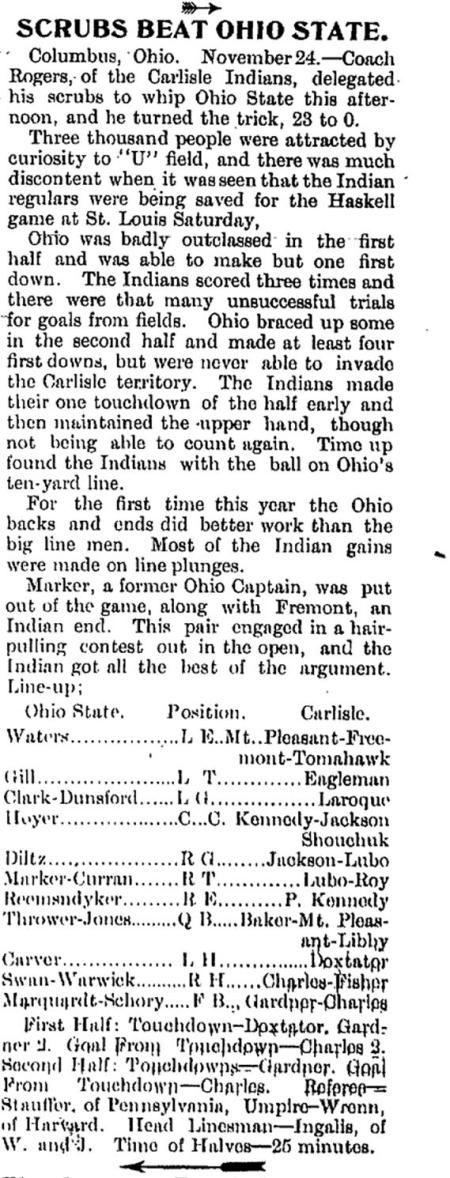
Frank Loney, a collector of Carlisle memorabilia, called to ask about a football player named T. A. Engleman. He had a letter written by a Carlisle Indian School football player who was visiting the St. Louis World’s Fair. The letter was written the morning of the big game against Haskell Institute on the Saturday after Thanksgiving in 1904. The letter was written to Mr. Ziegler in the harness shop at the Indian school.

Frank could find no student named Engleman listed in Linda Witmer’s book, so further research was necessary. Steckbeck listed an Eagleman. The author of the letter wrote, “The second team played the Ohio State University on the 24th, Thanksgiving-day. I played out the whole game, and felt as though of being eighty years old after the game. My man was more than two hundred pounder and so you can imagine I had something to buck up against.” I knew that the first team sat out the Ohio State to be rested for the big game with Haskell that President Roosevelt was expected to attend. Finding a newspaper write-up of the game that included line-ups, I noticed that a player named Eagleman played left tackle across from either Gill or Marker. Because Marker was ejected from the game along with Fremont for engaging in a hair-pulling contest, Gill must have been the 200-hundred pounder and Eagleman was Engleman or vice-versa. Ticket prices for the Carlisle-Ohio State contest, a deluxe game, ranged from 25 cents to a dollar. Ohio State’s only other deluxe game was with the University of Michigan.

Witmer’s book listed an Eagle Man but no Eagleman. However, various censuses listed Thomas A. Eagleman, Sioux. He married a white woman, Grace More, in 1909 and they had 3 sons and 5 daughters. They farmed near Crow Creek in South Dakota, probably on an allotment.

Mystery solved.

 carlisle-ohio-state

Some Good Scholarship

February 9, 2009

A couple of years ago Angel DeCora’s biographer wrote, “I noticed Benjey did not seem to have access to several of my sources, including Ewers’ papers from the Smithsonian archives…” I didn’t understand her comment because I did have access to John C. Ewers’ Smithsonian file. However, I found some errors in his article on Dietz and saw no point in including those in my book. Now I know what she meant. In a chapter on Dietz that was removed from her recent book, Linda Waggoner makes the following statements:

When his sentence was over, Dietz returned to the east, taking a temporary job at the Philadelphia School of Industrial Art in “Design and Lettering” for the 1920-1921 academic year.[63] Perhaps, he wanted to revisit the past he spent with Angel, but football was still his first love. In 1922 he was hired to coach at Purdue University in Indiana. At the end of January 1923 he married Doris O. Pottlitzer, a “Jewish heiress,” just a week after he was fired from Purdue for illegal recruiting.

Like Ewers before her, Waggoner appears to have misinterpreted The Pennsylvania Museum and School of Industrial Art Circular for 1920-21. Beginning on page 41 of that circular is a list of former students and their last known occupations. They were probably not aware that Dietz was no longer teaching at Carlisle and hadn’t been doing that since 1915. Sara MacDonald, Public Service Librarian at The University of the Arts, successor organization to The Pennsylvania Museum and School of Industrial Art, explained this to me some years ago and reiterated that again last week.

uart1920-21

Waggoner’s explanation would have been convenient for me because I haven’t found out what Dietz was doing in the year between when he got out of jail in 1920 and the time he took the coaching job at Purdue in 1921. I have no explanation as to why Waggoner has him coaching the Boilermakers in 1922 and marrying Doris in 1923. He coached Purdue in only one year, 1921, and married Doris in early 1922. They then relocated to Ruston, LA where he coached Louisiana Tech in 1922 and 1923. Lone Star may have thought Doris was a cracker heiress, but it doesn’t look like she was. I suspect that his 1-6 record at Purdue had more to do with his firing than the accusations made against him.

The blog’s owner responded to the Waggoner post that included the above extract as follows:

I look forward to some real scholarship about Dietz’ true identity. I think it’s time to clear this up. Please keep a’goin with this. For those unaware, ‘Keep a’goin'” is the phrase that repeats in the chorus of the Carlisle Indian School song Pop Warner is credited with writing.

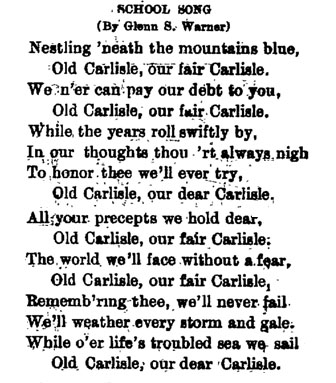
Here’s some real scholarship. “Keep a-goin’” was NOT a phrase that Warner repeated in the Carlisle school song. Follows is the school song as published in the January 25, 1907 edition of The Arrow. Also included is the poem from his 1927 book, Football for Coaches and Players, the place where the phrase can actually be found.

 carlisle-school-songkeep-a-goin-poem1


I picked this phrase for the title of Lone Star Dietz’s biography because of the way he kept going in spite of numerous setbacks and because he had it in his hand when he died. He also illustrated the book from which it came.


No Super Bowls for Carlisle Indians

February 2, 2009

Carlisle Indian School football players retired from football decades before Super Bowl I in 1967. In fact, many, including Jim Thorpe and Lone Star Dietz, if not the majority, were already dead. The closest tie to either of this year’s competitors: the Cardinals and the Steelers, is that Jim Thorpe played for the Cardinals in 1928. Thorpe was over 40 then and came out of retirement, after hanging up his cleats at the end of the 1927 season as player-coach of the Portsmouth Shoe-Steels, for what was probably the last time to help the hapless 1-4 Cardinals in a Thanksgiving charity game against their cross-town rivals, the Bears. Big Jim was well past his prime and didn’t play much in this 34-0 pasting, their fifth shutout loss of the year and third in six days. Thanksgiving Day games didn’t replace a Sunday game in those days, they were just inserted into the schedules. The Cardinals lost to Frankfort 10-0 on Saturday, November 24, 19-0 to the New York Yankees the next day, and closed out their season on Thursday, November 29 against the Bears. Thorpe didn’t have enough left in his tank to help a team that gave up 63 unanswered points in these three games.

The Chicago Cardinals were a charter member of the NFL, which originally called itself the American Professional Football Association, but weren’t the Chicago Cardinals in 1920 when the league was first formed. The oldest and losingest team in the league traces its roots back to a sandlot team in Chicago before the turn of the last century. The team claimed its name in 1901 when, a derisive description of his team’s faded maroon jerseys that had been surplussed by the University of Chicago, caused team owner Chris O’Brien to spin that lighter color into cardinal red. They have been the Cardinals ever since. At the time the pro league was formed they were known as the Racine Cardinals because they were located on Racine Street. In 1960 they moved to St. Louis and in 1988 to Arizona. Along the way they won two championships, but one, for 1925, is disputed by the Pottsville Maroons faithful. Thorpe didn’t have much time to think about the loss because his All-Indian basketball team started its season on December 2 against the Detroit Tool Shop Club.

sportraitsthorpe

Common Misconceptions About Carlisle Indian School

January 26, 2009

Google Alerts inform me of “news” on the internet regarding Lone Star Dietz, most of which I ignore. Although the most recent alert was a message largely concerned with Moses Friedman, that blog contains some misconceptions that are probably widely held. Matt is understandably confused by some of the entries on Friedman’s draft card (below) but those inconsistencies aren’t the worst problems. The misconceptions I consider serious are discussed in the paragraphs that follow.

  1. He could pass off the Moses as a given name perhaps, but not Friedman, especially considering that students kept an anglicized version of their Native name.

While it is true that some students were assigned anglicized versions of their original names, my experience researching Carlisle Indian School football players has been that the Anglicized names were generally assigned to an elder in the family, often at the agency in which the family was recorded. By the time Carlisle started fielding a football team in the 1890s, there had been so much intermarriage between Indians and whites that the majority of players I researched carried the family name of a white ancestor. For a small example, I seriously doubt if any of the six Carlisle Indians who were inducted into the College Football Hall of Fame carried Anglicized names, bastardized perhaps, as in the case of Guyon. Those names are:

a.     Albert Exendine (may have originally been Oxendine)

b.    Joe Guyon (probably Guion originally)

c.     James Johnson

d.    Ed Rogers

e.    Jim Thorpe

f.      Gus Welch

Had Friedman’s father married an Indian woman, he could easily been named Moses Friedman, although I am unaware of any evidence that indicates that he has Indian heritage. The point is that his name said nothing, one way or the other, about whether he had Indian heritage or not. Another point is that the Anglicized versions that are known for these men, Bright Path (Jim Thorpe) for one, are nothing like the names they were known by at Carlisle.

  1. My initial thoughts were of Lone Star Dietz, but why would he attempt to pass himself off as Indian with such a German sounding name?

As shown by the sample of European names above, by the 1890s a mixed-blood Indian could carry almost any European surname. Germans may have intermarried less than the French, English and Irish, but surely some did. Having the last name of Dietz (or Deitz as his father spelled it), is probably the weakest argument against him.

  1. However, Native-Americans were not exempt from the draft, …

Non-citizen Indians were exempt from the draft, but citizens weren’t. Indians as a group weren’t granted citizenship until after WWI, so most were not required to serve. However, the fact that so many volunteered and served with distinction speaks well for their bravery and patriotism. A significant number even went to Canada to enlist before the U. S. entered the war.

  1. As an aside, even though I have his date of birth I cannot find any Moses Friedman born in America, let alone Cincinatti [sic], on that date or even in 1874!

It was not unusual at all for births not to be recorded at that time. My own paternal grandmother had no birth certificate and she was born over a decade later.

Friedman’s draft registration is surely confusing, most likely because he was confused. As to why he would check the white box for race and also check the citizen box for Indian: my guess is that, knowing people of any race could be citizens or non-citizens, he ignored the Indian heading when he checked the citizen box. I am unaware of any attempt by Friedman to claim Indian heritage.

A look at his then current employment might shed some light as to why he put Carlisle as his permanent address. He was then doing “special work as stockman for NY Supreme Court” in Taos, NM. After resigning from his position as Superintendent of Carlisle Indian School and being acquitted in Federal Court, Friedman was probably taking any work he could get. His work in Taos sounds like it was temporary and Friedman may have had as yet established a permanent location after leaving Carlisle.

http://ciis.blogspot.com/2009/01/moses-friedman-and-lone-star-dietz-both.html
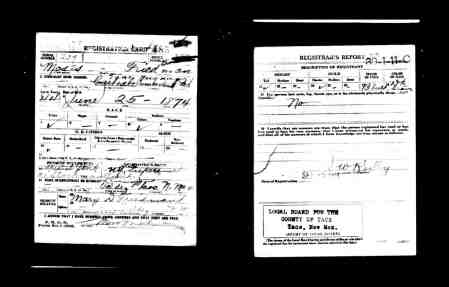
wwidraftcard-friedman

1905 Inaugural Parade

January 23, 2009

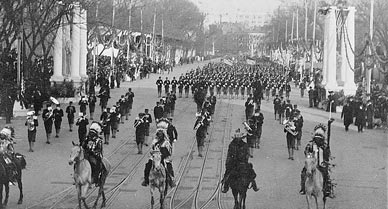
The 1905 Presidential Inauguration was a big deal, especially for Carlisle. They had marched at inaugurations before, but this one was special. President-elect Teddy Roosevelt wanted to “make a big show,” likely because his first inauguration was a short, somber affair held in the home of Ansley Wilcox after President McKinley’s assassination. They pulled out all the stops to make his 1905 inauguration a day to remember. Already a staple of inauguration parades after appearing in two previous ones, the Carlisle Indian School Cadets (essentially the large boys) and the renowned school band were expected to march again. However, this time some celebrities would appear with them.

A week or so before the inauguration, six famous chiefs from formerly hostile tribes, arrived in Carlisle to head the school’s contingent in the parade. But, before they left for Washington, there was much to do. First, they spoke to an assembly of students through interpreters. A dress rehearsal was held on the main street of Carlisle to practice for the parade. The Carlisle Herald predicted that the group would be one of the big parade’s star attractions.

Those marching in the parade were woken at 3:45 a.m., had breakfast at 4:30, and were the special train to Washington at 5:30. As the train rolled out of Carlisle, a heavy snow fell, but later the sun burned through, making for a fine day weather-wise. Fortunately, the travelers had lunch on the train because it was late in arriving in Washington. They were hurried into the last division of the Military Grand Division. Originally, they were to have been in the Civic Grand Division, but Gen. Chaffee transferred all cadets under arms to the military division, putting them in a separate brigade. Leading the group was Geronimo, in full Apache regalia including war paint, sitting astride his horse, also in war paint, in the center of the street. To either side, on their horses in their regalia and war paint, rode the five other chiefs: American Horse (Oglala Sioux), Hollow Horn Bear (Brulé Sioux), Little Plume (Blackfeet), Buckskin Charlie (Ute), and Quanah Parker, (Comanche). Following them came the 46-piece Carlisle Indian School Band led by Claude M. Stauffer. Capt. William M. Mercer, superintendent of the school and member of the 7th Cavalry, led the 350 Carlisle Cadets from horseback.

All in President’s box rose when the Carlisle contingent passed. The old chiefs were the object of the most interest from the crowd. Roosevelt said, “This is an admirable contrast-first the chiefs, in their native costumes and then these boys from Carlisle.” Marching ahead of Carlisle in the Military Grand Division were the Cadets from West Point and the 7th Cavalry, whose band played “Garry Owen,” their regiment song, when they passed. President Roosevelt remarked, “That is a bully fighting tune, and this is Custer’s old regiment, one of the finest in the service.” Capt. Mercer surely heard his regiment’s song and may have requested the Carlisle band to play it on occasion.

Perhaps being in close proximity to the War Department and West Point officials gave Mercer the opportunity to discuss a football game between Carlisle and Army. About six weeks later a game between the two government schools appeared on a schedule published in the school paper. The historic event would take place the following November 11.

Six chiefs lead, followed by the CIIS band and 350 students

Six chiefs lead, followed by the CIIS band and 350 students


Foul Weather Spoils Inauguration

January 20, 2009

Good weather was expected for the inauguration of President Taft in 1909. Carlisle Indian School students had been a staple of inaugural parades for some time and began making preparations for the parade as early as late November of the previous year when The Carlisle Arrow announced that the tailoring department was to make 350 cadet capes for Taft’s inauguration in early March. (Yes, inaugurations were held about six weeks later in those days.) Later issues monitored the status of the cape production. But when the inauguration came and passed, The Carlisle Arrow had nothing to say about it. How could this be when the Carlisle contingent had been so prominent in Roosevelt’s 1905 inaugural parade?

The answer, it appears, has to do with the state-of-the-art of weather forecasting at that time. High winds and 10 inches of snow where what Washingtonians got instead of the fair weather that was predicted. Cold temperatures that accompanied the blizzard caused the swearing-in ceremony and the speechifying that are part of it to be relocated to the Senate, but didn’t cancel the parade. The parade was held but was smaller than expected. Newspaper coverage, like that of the Carlisle Indian School publications, contained no mention of the Carlisle contingency marching in the parade. News reports on the weather described how the snowstorm shutdown transportation in and out of the Capital. Trains from all four directions were blocked by the snow and couldn’t get into town. West Point cadets got a lot of press for actually marching in the parade, enthusiastically at that, after getting off their train in Baltimore and marching 40 miles to get to the parade route.

It seems likely that the 350 Carlisle boys were on one of those trains that didn’t make it into the city and missed the parade. The March 12 issue of The Carlisle Arrow related, “Several of our students had the satisfaction of seeing the inaugural parade at Washington.” Those students most likely weren’t part of the contingent who were to have marched.

1909-inauguration-button

Carlisle Players Play Each Other

January 19, 2009

While researching the lives of Henry Roberts and Mike Balenti, I became aware that they, and some other Carlislians played against each other when enrolled in other schools. In response to criticism that Carlisle Indian School had been playing some of the same people for too many years, Pop Warner instituted a policy that limited players to four years on the varsity squad. Mike Balenti had used up his eligibility at Carlisle and Victor Kelley had one year of eligibility remaining at the Agricultural and Mechanical College of Texas. While there were no national eligibility standards, many colleges limited students to four years of eligibility, one for each of their four years of college – assuming that they finished on time. However, colleges often conveniently ignored the time former Carlisle players now at their institutions had played at the Indian school because it wasn’t a college academically. In fact, it wasn’t even a prep school. Putting these vaguaries of eligibility aside, Mike Balenti and Victor Kelley enrolled at A&M (reenrolled in Kelley’s case) to play under new head coach Charlie Moran. Moran, coincidentally, had assisted Pop Warner at Carlisle the previous year before embarking on a career as football coach. Previously, he had been a star player and a baseball coach, but hadn’t coached football. The Aggies, with Kelley at quarterback and Balenti at left halfback, had a powerhouse team. One of the obstacles in their path to the unofficial Southwestern Championship was Haskell Institute. The teams met on October 23 at College Station. Captain and left end of the Haskell squad was Henry Roberts who would later star of Carlisle’s great 1911 team. Not on the field that day for Haskell, but on the squad, were center Nikifer Schouchuk and quarterback Louis Island. It was like old home week at the game which the Aggies won 15-0. Aggie students celebrated wildly after the game because beating the team that had beaten the University of Texas meant a lot to them. At the end of the season Charlie Moran, as coach of the Southwestern Championship team, was given the honor of selecting an All Southwest team. He named Kelley for quarterback, Balenti for left halfback, and Roberts for punter. Carlisle was well represented on that team by alums both past and future.

Indians Were Poor Marksmen

January 10, 2009

Over a century before Rush Limbaugh roamed the airwaves, Rush Roberts, whose Pawnee name translates to Fancy Eagle, roamed the Great Plains. While researching the life of Henry Roberts, left end on the great Carlisle Indian School football team of 1911, for my upcoming book, Oklahoma’s Carlisle Indian School Immortals, I came across the fact that Henry’s father was a quite colorful character.

In 1876, at age 16 or 17, Rush was recruited as a scout for the U. S. Cavalry, becoming the youngest man to fight under Gen. Crook in this campaign. It is documented that he participated in the November 25, 1876 Dull Knife-Mackenzie Fight (aka Battle of Bates Creek) as a member of the Pawnee Battalion. The Pawnees were credited for fighting with exceptional capability against one of their ancient enemies. He was awarded his father’s name, Fancy Eagle, for his bravery in battle. Almost a decade after the war ended, he enrolled as a student at Hampton Institute in Virginia. He stayed there for two years and later sent two of his children, one of whom was Henry Roberts. Rush eventually became a chief of the Skidi Pawnees and lived to an old age. His exploits ares mentioned in We Remember: the history of the U. S. Cavalry from 1776 to the present by Edward L. Daily.

In an interview about the plains wars, Rush stated that, in general, Indians weren’t good marksmen with rifles. The problem was that they didn’t understand how to use the rear sight and wind gauge to hit their targets at long distances. However, they were excellent at shooting from horseback, particularly at short range. Rush explained, “The group formations of the army made a bigger target, but army marksmanship was better and steadier.”