Archive for the ‘Carlisle Indian School’ Category

Harvard Law School All Stars

April 20, 2010

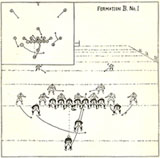
A November 16, 1910 Washington Post article listed Harvard Law’s star-filled line-up. The next day’s game report modified it a bit, including the substitutes who played in the game. The Indianapolis Star refined it further. Follows is an amalgam of the three:

Player Position College
Logan Left End Yale
Crumpacker, Withington Left Tackle Michigan, Harvard
Matters Left Guard Nebraska
Cass Center Princeton
S. Hoar,                     Dore Right Guard Harvard, Harvard
Hamilton Fish Right Tackle Harvard
Triggs Right End Holy Cross
S. H. Philbin Quarterback Harvard
Pfeiffer,                     Page Left Halfback Princeton, Harvard
H. Moore Right Halfback Harvard
White,              Simmons Fullback Harvard, Princeton


P. Withington was a second team Walter Camp All American in 1909.

L. Withington was a third team Walter Camp All American in 1909.

It isn’t clear which of the former Harvard linemen played on the Harvard Law School team.

Hamilton Fish, organizer of the team, was a Walter Camp first team All American in 1908 & 1909.

S. Hoar was a 1908 third team All American in 1908

S. H. “Steve” Philbin was a Walter Camp first team All American in 1909.

 The team was as advertised. It was indeed loaded with former college stars who today might be playing in the NFL.
1910 Carlisle-Harvard Law Game

April 15, 2010

A minor mystery surrounds Carlisle Indian School’s game against Harvard Law School in 1910. Carlisle and Harvard played several times but not in 1910. Schedule conflicts may have had something to do with it. Or it might have been due to money. In April of 1910, Pop Warner announced his schedule for that year’s football team. He packed 14-games into a season that ended with the annual Thanksgiving game with Brown at Providence. New rules were instituted that year that were favorable to the Indians’ style of play, so Warner felt comfortable in upgrading the schedule. He scheduled away games on successive weeks with Syracuse, Princeton, Penn, Virginia (at Washington, DC), Navy, Cornell and Brown. Cornell—a difficult schedule, indeed. By the fall, Cornell had been replaced by Johns Hopkins with no reason being given for the change. A warm-up game with Western Maryland College was canceled after the season started. The November 4 edition of The Carlisle Arrow listed a schedule that included no mention of a game with Harvard Law School. However, the December 2 edition listed the score of the game but had the date wrong. It may be that Warner scheduled the game with little notice because Harvard Stadium was available due to the Crimson having departed to prepare for their upcoming game with Yale in privacy. The Harvard Law-Carlisle game was actually played on November 16. Steckbeck copied The Arrow’s errors into his book. Apparently, he didn’t have out-of-town newspapers at his disposal.

Some November 16, 1910 newspapers from around the country announced that Carlisle was going to play a “hand-picked eleven” representing Harvard Law School. One announcement from an anonymous newspaper writer declared that the Indians’ opposition “is the nearest approach to an all American eleven ever seen in action.” Next time we will explore exactly who these All Americans were. Perhaps a reader who is descended from one of these men can provide more information.

Seek Restoration of Indian School

April 12, 2010

When looking for information on Asa Sweetcorn, I found a 1935 United Press article in which he was mentioned that had nothing to do with his exploits while at Carlisle. Titled “Seek Restoration of Indian School,” the article, datelined Carlisle, Pa., March 15, the article told of former Carlisle Indian School students’ attempt to reopen the school. Charles Dillon, who is best known for his role as “humpback” in the “hidden ball” play run against Harvard in 1903, spearheaded the movement. “Dillon, one of the greatest of the long line of football heroes who wore the colors of the old Indian School, was in town the other day sounding out sentiment on the proposed return of the Redskins.”

Dillon was on his way to Washington, DC to pry loose a few New Deal dollars to launch the program. He felt that little government money would be required to fund the school. He told some old friends in Carlisle, “Our aim is to build a college with Indian money, to be conducted by and for Indians. And only a comparatively few dollars are needed from the government to launch the program.” According to Mr. Dillon, “Scores of graduates of the erstwhile Carlisle Indian School are ready to contribute thousands of dollars toward establishing the school.”

He was to return to Carlisle the following week after negotiating with New Deal officials. Accompanying him were Jim Thorpe, Gus Welch, Albert “Chief” Bender and Asa Sweetcorn. That was a bad time for Indian schools to pry money out of the government. Lone Star Dietz left Haskell Institute in 1933 to coach the Boston Redskins after the government slashed Haskell’s budget. Gus Welch was well aware of funding issues as he replaced Dietz at Haskell. It is easy to understand why Dillon, Thorpe, Bender and Welch supported the initiative because they flourished at Carlisle. Sweetcorn’s involvement is curious because he was “canned” in Carlisle for his antics that reflected less than a studious attitude.

Source of Sweetcorn Misinformation

April 8, 2010

A July 1970 article about the Sisseton-Wahpeton tribe’s alcohol program that was written by Homer Bigart for the New York Times News Service appears to be the source of much of the misinformation about Asa Sweetcorn that Sally Jenkins used in her book about Carlisle Indian School. One paragraph from this unsourced article is the major culprit:

The most illustrious member of the tribe was Asa Sweetcorn, an all-time football hero who played with Jim Thorpe at Carlisle. Asa was a giant who reputedly wore a size 21 collar and could ram his head through wooden doors.

A quick look through Carlisle Indian School newspapers uncovered no mention of Asa Sweetcorn in any year other than 1910. The Washington Post listed him as the starting left guard for the game against Virginia. This supports Gus Welch’s assertion that Sweetcorn was a “running guard.” School newspaper coverage of some other 1910 games mentioned his play. No mention of him being in a Carlisle game before or after 1910 was found. Steckbeck only lists him as being on the varsity squad in 1910. However, his rosters were often incomplete. Asa may have been on the varsity before 1910 but wasn’t a starter. But no evidence has been found to support that.

So, Sweetcorn was not a star on the 1910 team, or any other year. So, he definitely wasn’t “an all-time football hero.” He didn’t play on the varsity with Jim Thorpe, as Thorpe only played on the varsity in 1907, 1908, 1911 and 1912. He was not at Carlisle in 1910 when Sweetcorn played. So, the two didn’t play on the same team unless, when younger, they played on a shop team together.

Sweetcorn may have bulked up after leaving Carlisle, but Welch’s description of him and his photograph in uniform differ from that. He was anything but a giant when at Carlisle. It is possible that he gained so much weight later that he needed a size 21 collar, but he surely didn’t when he was at the Indian School.

Dennison Wheelock Sent His Son to Carlisle

April 1, 2010

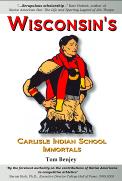
While working on Wisconsin’s Carlisle Indian School Immortals, the idea came to me that some tidbits of information may be in Dennison and James Wheelocks’ files at the National Archives that may also pertain to their younger brothers, Joel and Hugh. The copies of their files arrived this afternoon. Dennison’s file opened to an August 1914 letter from him to Oscar Lipps, Acting Superintendent of Carlisle Indian School. Dennison graduated from Carlisle and was later bandmaster at Haskell Institute and Carlisle. After touring with his own band, he returned to West DePere, Wisconsin where he practiced law and participating as an officer of the Society of American Indians. His letter began:

“My sister, Martha Wheelock, aged twenty years, whose term expired at Flandreau, South Dakota last June, and is now with me in West DePere, desires to be admitted to the Carlisle Indian School as a pupil. I am very anxious that she shall go if possible. She is in eighth grade. My son, Edmund, who was born at the Carlisle Indian School, in1896, is also very anxious to have the benefit of a diploma from Carlisle on account of the prestige it carries with it throughout the West….”

Both were admitted and were attending Carlisle within a month. Both were active in school life and joined literary societies shortly after enrolling, Martha in the Susans and Edmund in the Standards.

Edmund had been attending public school in Wisconsin and doing well but his father was concerned about the environment. “Unfortunately, however, DePere is a city of less than five thousand inhabitants, yet has in the neighborhood of twenty-two, or twenty-four saloons, and on account of what is falsely termed liberal sentiment, the saloon keepers do not hold strictly to the law of the land, and as a result we see young boys very frequently under the influence of liquor.”

Dennison Wheelock was pragmatic about where Indian children should be educated. He preferred that they be enrolled in the public schools unless there was good reason to send them elsewhere. His experience at Carlisle evidently convinced him that it was a better environment for his son than his home town.

Sweetcorn Fools Sally Jenkins

March 30, 2010

Last time, Asa Sweetcorn explained his strategy for getting more attention from sportswriters to Gus Welch. As it turns out, the wily Indian continued to fool sportswriters long after his death. Welch described his former teammate: “This Sweetcorn was a very rugged Indian, although he only weighed about 160 pounds and probably nowadays [1933] would just be turned over to the intramural department.”

On page 258 of The Real All Americans, Sally Jenkins describes Sweetcorn: “He was an enormous, brawling, swilling man who wore size twenty-one collars and was able to ram his head through a wooden door in a liquored-up stupor.” Welch definitely didn’t describe Sweetcorn as being enormous. To the contrary, at about 160 pounds he was far from large as a football player in his day. Two decades later, he would not be given a chance to make the varsity in Welch’s opinion.

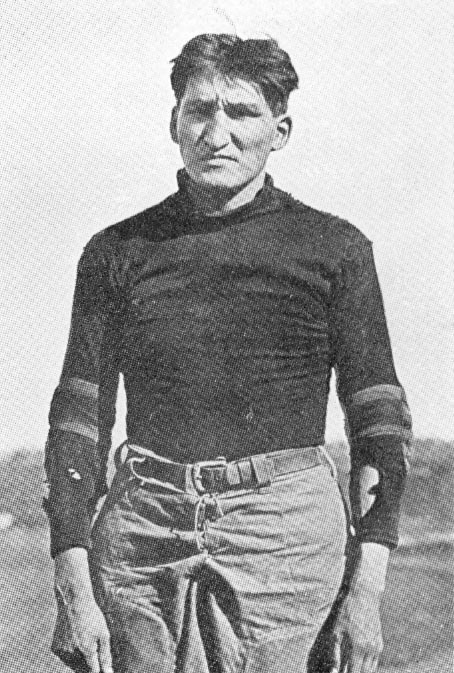
A photo of Sweetcorn in his Carlisle Indian School football uniform supports Welch’s description. He appears to be no larger than average size and without a thick neck. If Asa ballooned up to the size Jenkins described, it must have been after he left Carlisle.

The condition of Sweetcorn’s jersey in the photo supports Welch’s assertion that he received quite a beating in some games. Why he was wearing that particular jersey is unknown. What is known is that new jerseys were in limited supply. Each year, the varsity players got new jerseys and handed their old ones down to the second team who handed them down to the third team or the junior varsity who in turn handed their old ones down to the shop teams. It’s likely that his old jersey was in better shape than this one, but he may have worn this one as a badge of honor to reflect his toughness.

Asa Sweetcorn, Carlisle’s Wild Man

March 26, 2010

As so often happens, I came across an interesting article when looking for something else. This time it was a 1933 interview of Gus Welch by Alan Gould of the Associated Press. By this time Gus Welch had gained a reputation as a great storyteller, having won the coveted Brown Derby Award at annual coaches conferences. For whatever reason, no award was made in 1933 but Welch told an interesting story about, as were many of his stories, a teammate at Carlisle. He recalled a headstrong player named Asa Sweetcorn who, as a running guard [probably a pulling guard in modern parlance], felt that his contributions were being disregarded in Warner’s newspaper columns. He reacted by drawing attention to himself. Instead of running plays as his coach diagrammed, Sweetcorn “…would go ripping around an end, legs and arms flying, making gestures at everybody but taking out nobody. I took him aside to find out what was going on. Slyly he wispered to me: `Gus, that’s psychology. I keep `em all worried and guessing and then they say, My what a great running guard this Sweetcorn is.’”

 Reporters rewarded him with positive mention in their columns and opposing teams started to take notice of him. Navy concentrated much of their effort against Sweetcorn to his detriment. Soon he was groggy and bloody. At half-time, Pop suggested that a substitute be sent in for him. Welch responded, “No, this Sweetcorn is just faking. Let him stay in.” After taking terrible beatings game after game, Asa began to wise up a bit but not completely. Lying on the field badly beaten in a game, he had about reached the limit of punishment he could withstand, he said something to Welch about needing a “medicine man” but Welch disagreed, “Never Mind medicine man; send for a priest.”  

 Next time, find out how Sweetcorn fooled Sally Jenkins.

More on the Writer’s Digest review

March 24, 2010

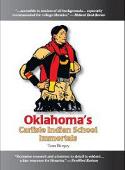
This time we’ll discuss other parts of the Writer’s Digest review of Oklahoma’s Carlisle Indian School Immortals, beginning with “The U. S. tendency to treat Native Americans like animals means that their biographies reflect the glory of sports—and the sorrow of poverty and bigotry.”

For starters, biographies of these men must “reflect the glory of sports” because, in their youth, these men were famous across the country as a result of their athletic abilities. Sure, newspaper coverage was often racist but it was respectful of their abilities and accomplishments. Sports opened doors to them that were not open to most young whites of that period. College was largely reserved for the elite. Few from the working class darkened the doors of these hallowed institutions. However, several Carlisle Indians were enrolled in major universities. These same schools complained about Carlisle not conforming to the same eligibility rules that they gave lip service to while recruiting the Indians to leave Carlisle and come play for them.

Others leveraged their Carlisle fame into jobs away from the reservations where opportunities were few. Not many of them became rich, but sports were not a route to wealth for all but a few in those days. Amos Alonzo Stagg was probably the highest paid man in sports because he was making $6,000 a year as a tenured professor with the University of Chicago. Jim Thorpe’s contract with the New York Giants paid him as much but only for five years. It wasn’t until Red Grange and Babe Ruth arrived on the scene that athletes became rich. By then, the Carlisle Indians who hadn’t retired from competition were in the twilight of their athletic careers.

Most of the Carlisle football players I have researched rose from poverty into the middle class. Many of them worked with their hands in occupations that some consider menial today. But most Americans worked in “menial” jobs those days and very few went to college. The grandchildren of these men who have contacted me have gone to college and living middle-class lives. Ironically, their family histories parallel those of immigrant groups given that Indians are the only non-immigrants in the country.

Review of Oklahoma’s Carlisle Indian School Immortals

March 19, 2010

Writer’s Digest just sent me a review of Oklahoma’s Carlisle Indian School Immortals that included something interesting. Before we get to that, you can read the short review in its entirety:

I knew Jim Thorpe would be in this book, and he is; but I didn’t know how many honors he had earned. Didn’t the Olympic Committee restore his medals, also? Well, besides Thorpe and his athletic prowess, this fine little book offers stories about a number of other fine students, All-Americans and later coaches. The U. S. tendency to treat Native Americans like animals means that their biographies reflect the glory of sports—and the sorrow of poverty and bigotry. If those students had cried all the tears they earned, Oklahoma would be a swamp. I wish the author had had time to write a book about each of the men.

I take the comments that “this fine little book” and the wish that I had “time to write a book about each of the men” as compliments. However, I feel that I should address some of what was said in the review lest the reader be misled. Of course the reviewer is correct in stating that I don’t have time to write book-length biographies for all these men. But time isn’t the reason I didn’t and don’t expect to be able to do that. Availability of information is the determining factor. The men about whom I write typically left few papers behind and none wrote memoirs. Occasionally, I locate one of their children but most of them are now deceased. Grandchildren are often interested in their grandfathers’ lives but most have little information about them. It is wonderful when they do.

These men, like most Americans of all races, generally worked at their jobs, paid their taxes, supported their families, survived the depression as best they could and sent sons off to fight in WWII. After being famous in their youths, they lived quiet, productive lives typical of their generation. Unfortunately, that usually doesn’t create enough material for a book.

A grandchild of one such man wrote me recently to inform me that she had read the chapter about her grandfather and told me that she was amazed at the amount of material I had found about him. Granted, his name found its way into his local newspapers much more than most but he left far too little information behind for a book.

Some of the reviewer’s other statements deserve comment and will be addressed next time.

Cause of Oscar Hunt’s Death

March 16, 2010

I spent some time researching the cause of Oscar Hunt’s death. First, I thought if I could locate his death certificate, I would find out what caused his death. I quickly learned that death certificates were not issued in Oklahoma till later that year and were not required then. It was some time that death certificates were routinely issued in Oklahoma.

Next, I thought if I could locate the court records, they might contain something about his death. Because newspaper articles stated that his case was in Federal Court at Afton, Oklahoma, I contacted the Northern District Court in Tulsa. Their clerk informed me that the court did not exist until 1922 and referred me to the Eastern District Court in Muskogee. Their records don’t start until later in 1907 and a quick check of their card file found nothing. The clerk suggested that I contact the county court. Since Afton is split between two counties, Jay and Ottawa, it was necessary to contact both of them. Unfortunately, they had no records prior to statehood. A clerk did recommend that I contact the Muskogee Court House because that court was older than many others. Muskogee had nothing prior to statehood, either.

No one seems to know if records for trials that took place in Indian Territory still exist and, if they do, where they are preserved. My next stop is at the National Archives in Fort Worth. I fear that finding Hunt’s legal records will be like looking for a needle in a haystack.