Archive for the ‘Carlisle Indian School’ Category

The Lonestar Family

April 7, 2011

Frank Lonestar was listed as playing for the Columbus Panhandles, an early NFL team, in 1920. Because he died in 1915, it seems likely that someone else played under his name. Not knowing much about him prompted me to look into his background a bit. His Carlisle Indian School student file contained a lot about what he did while there and after he left, but contained little about his heritage. It stated that his parents and only sister had all died of consumption. His only brother, John, was in good health and served as Frank’s guardian. A note in his file indicated that his brother had also been a Carlisle student.

John Lonestar’s Carlisle student file listed his parents as living at the time of his 1891 enrollment and that his father’s name was also John Lonestar. His Chippewa name was listed as Ke-wa-ge-zi-qne-ba. John left Carlisle in April 1895 to escort his sister. One assumes that she was ill and was taken home at that time. Unfortunately, I don’t know what her name was.

Bonnie Brandt of Spooner, Wisconsin has found some information on the Lonestars. In 1917, John inherited property from Ge bit we gi jig due to his being the son of this person. But who was this person? Bonnie located his marriage record to Rebecca Hart in February 1899. That record listed his father as John Star (perhaps just abbreviated his name) and his mother as Sarah Shinneway, a name that is often spelled a number of different ways. Frank’s death records indicated that his father, John, was born in Wisconsin and that his mother was Sarah Shiniwa, also born in Wisconsin.

John Lonestar the younger first appeared on the censuses in 1905. The elder John Lonestar doesn’t seem to appear on any of them. That may be due from them being members of the Lost Tribe of the Chippewas. Any information on the Lonestar family would be most appreciated.
1903 Season Ender Against Sherman Institute

April 5, 2011

A while back, I was asked about the scheduling of the Carlisle-Utah game on December 19, 1903. Based on what I had read at the time, I concluded that the reason for the trip to California trip that year was to play Reliance Athletic Association on Christmas Day in San Francisco and that the game with Sherman Institute on New Year’s Day in Riverside was a side trip. Well, that may actually be the opposite of what was the case.

In 1902, Carlisle alum Bemus Pierce took the job of coaching the Sherman Institute team in Riverside, California and, apparently, took it pretty seriously. CFBdatawarehouse.com lists their record as 8-1-0 with the Stanford & Santa Ana All-Stars being the team that scored the 6 points total scored against them that season. Victories included a 34-0 thumping of Occidental College and a 28-0 thrashing of Southern California, which many call USC.

The 1903 season didn’t turn out as well. Sherman Institute lost its season opener to Pomona-Pitzer in a more lopsided score than they had defeated them the previous year. They also lost to Stanford 18-0 but beat USC 12-0. With a 4-3 record, they were called West Coast Champions—surely a dubious title that year. Regardless, they suited up to play the eastern powerhouse in a New Year’s game.

Game reports indicate that this was one of the hardest fought games of football ever played in Southern California. Carlisle scored a touchdown just three and a half minutes into the game and would have been held with that score had it not been for a disputed play. Wilson Charles broke through the Sherman left tackle for a 45-yard touchdown run that the captain of the Sherman Institute team claimed was blown dead by Umpire Hauberman. Referee Tappan allowed the play. Sherman scored six points and lost 12-6 (Correct this score on page 47 of Steckbeck). Carlisle lost quarterback James Johnson and fullback Charles Williams early in the game to injuries. Sherman’s stars were Captain Neafus, for his fast playing, and Pierce for his defense work. So, it appears that Bemus Pierce suited up to play his old comrades. His playing days weren’t completely over. 

It wouldn’t be until 1916 that USC would beat Sherman Institute in the first game in which they scored on the Indians.

More on the 1899 Carlisle-Hamilton College Game

April 1, 2011

As an alumnus of Hamilton College, John Pitaressi, a reporter for The Observer-Dispatch, is familiar with the game and posted a comment to initial message about the 1899 Carlisle-Hamilton College game although he wasn’t present at it. He has two possible reasons for why the game was scheduled:

1. Melancton Woolsey Stryker, President of Hamilton College, was very much an admirer of the Carlisle team and a big believer in football as a maker of men.

2. Hamilton Coach Edwin Sweetland, a former Cornell player, had a relationship with Pop Warner that lasted for years.

These reasons sound plausible. The financial deal that was struck surely played a part but we don’t know (as yet) what that was.

The game received considerable build up in the Syracuse newspapers (Utica is east of Syracuse, between it and Albany) because their readers could easily catch a train to attend the game and Syracusans hadn’t seen the Indians play their local college team. That didn’t happen until 1906. According to the November 5 edition of The Sunday Herald, the Indians rarely played outside of New York City and Chicago. Omitting their homes games or games played across town at Dickinson College, the previous season, in 1898, the Indians played at Ithaca and Albany in New York; New Haven, Connecticut; Cambridge, Massachusetts; Philadelphia, Pennsylvania; and Chicago, Illinois. Carlisle obviously played in many cities, including two smaller cities in New York State. In 1899, they did play two games in New York City but none, other than the Hamilton game, in smaller New York cities.

The Herald went on to say that playing the game in Utica happened because of the efforts of Congressman James S. Sherman of Utica, chairman of the House Committee on Indian Affairs. I suspect that Pitaressi is closer to the truth that was The Herald because Carlisle was playing most any team they felt like except Army and the War Department approved that in 1905. That 5,000 bought tickets to see the game probably made it worthwhile for both schools. Playing the Indians probably helped Hamilton improve its level of play, because the next year, 1900, they went 8-1-0 with wins over Williams and Colgate.

1899 Carlisle-Hamilton College Game

March 28, 2011

Recently, I received a question about the 1899 Carlisle Indian School-Hamilton College football game. That person hadn’t been able to find anything about it and wondered if it was actually played. I had never given that game any thought because the Indians played three of the Big Four and beat Penn for the first time that year. 1899 was also Pop Warner’s first year at Carlisle and Walter Camp named Isaac Seneca to his All America First Team, the first Carlisle player to be so named. It’s easy to see why the game with Hamilton College could be overlooked. For starters, this was the first, and only time these two schools played. Secondly, the game was played in Utica, NY and was probably the only time Carlisle played in that town. Thirdly, even though Hamilton had been having decent seasons the past few years, they weren’t in the class of the big teams Carlisle normally played on the road. After all, Pop Warner’s Cornell team beat them 41-0 the previous year. But that may be the hint we’ve been looking for.

Pop Warner may have had a relationship with Hamilton’s coach plus Hamilton College may have offered Carlisle a good bit of money to play them. Clinton, NY, Hamilton’s home is near Colgate and Cornell plus Warner’s home was in Springville, NY. So, there may have been some familiarity. Hamilton was more than holding its own against Colgate at that time and was even competitive against Cornell in 1899. Hamilton supporters may have thought that they had a pretty good team that year and wanted to see how they stood up against a powerhouse.

I found Carlisle Indian School newspaper mention and New York Times coverage of the game, so it was definitely played. What is most interesting is why was it played? More research is needed to determine that.

Origin of Redskins Team Name

March 22, 2011

Every so often, either in a newspaper article or on a football forum, questions about the origin of the Redskins team name emerge. This time the question was raised on a www.extremeskins.com forum. Although it is repetitive to answer the same question periodically, it is probably necessary. A person interested in clarifying the issue asked me for a quote. It follows:

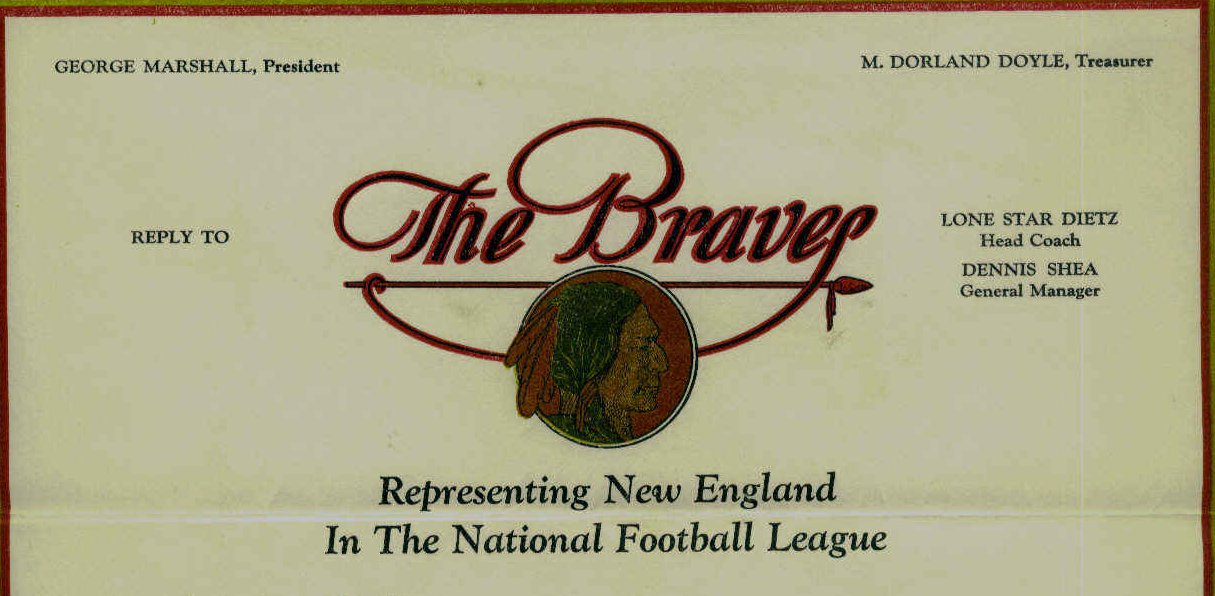
“Lone Star Dietz was hired to be head coach of the Boston Braves after the 1932 season. Sometime after his hiring, the team moved to Fenway Park necessitating a name change. I have seen Boston Braves stationery with Dietz’s name on it. That shows that he was hired before the name change. George Preston Marshall’s granddaughter wrote an op-ed to the “Washington Post” some years ago in which she stated that Marshall renamed the team in honor of Dietz (and, possibly, of the four Haskell players Dietz brought with him). Dietz coached the Boston Redskins in 1933 and 1934. This is all spelled out in my biography of Dietz.”

Some on the forum thought that the name change was influenced by the name of the baseball team that played in the Redskins new home of Fenway Park, the Red Sox. It may have. After all, Marshall could have named his team the Indians or something else in honor of Dietz. The Red in Red Sox may even have guided him toward Redskins without him realizing it.

Some sources state that the team name change occurred before Dietz’s hiring but I have evidence that contradicts that: Braves letterhead with Dietz’s name on it. It is highly unlikely that Marshall would have authorized the printing of letterhead with the wrong team name on it or with a name that he intended to change in the near future. That would have been wasting money, something that George Preston Marshall didn’t make a habit of doing. The masthead of that letterhead follows:

Were Carlisle Players Really Older?

March 17, 2011

While researching the last blog, I noticed that James Johnson was 24 at the time Walter Camp named him quarterback on his 1903 All America first team. His “advanced” age for a college football player brought to mind the criticisms that Carlisle Indian School played older players than did their college opponents. It seems logical that the Indians would have been older because most Carlisle students had little formal education prior to entering it. That Pop Warner considered their ages to be an advantage probably added to critics’ belief that Carlisle’s players were older. Something I saw on the list of Johnson’s All America cohorts caused me to see this in a different light.

Tackle J. J. Hogan (Yale) and guard A. Marshall (Harvard) were both 24 also and three others–end C. D. Rafferty (Yale), halfback W. M. Heston (Michigan) and fullback R. C. Smith (Columbia)—were 23. The others were 20, 21 or 22 as one would expect college All Americans to be. Perhaps 1903 was an anomaly, a year in which players were older than in other years. 1902 was a bit different; guard E. T. Glass (Yale) was 25! However, only one other player, tackle J. J. Hogan (Yale), at 23 was over 22. 1901 was greatly different than the two following years; three players—end D. C. Campbell (Harvard), tackle O. F. Cutts (Harvard) and guard W. G. Lee (Harvard)—were all 28 years old!! The rest were 20 or 21, but those three 28-year-olds brought up the average age. In 1900, end D. C. Campbell (Harvard) and halfback W. R. Morley (Columbia) were 27 and 24, respectively. Quickly scanning lists of Camp’s selection for years prior to 1900 yielded several players who were older than 23, some significantly older. After 1903, players aged 23 and older occurred less frequently but continued to be named to All America teams, even after Carlisle fielded its last team in 1917. As late as 1923, end H. H. Hazel (Rutgers) was 27.

While Carlisle players may have been a bit older on average than many college players, many of the best college players were quite old, much older than what we would expect today.

1903 Rule Changes Quarterback Position

March 14, 2011

Recently, I have received several questions about football rules that I couldn’t answers because I don’t have all the old rules books. BTW, if someone sends me a complete set of the Spalding Football Guides, I will be eternally grateful. By chance–the way I learn most things–I happened upon a rule change that I wasn’t looking for and of which I was completely unaware.

An August 7, 1903 New York Times article titled “New Rules May Require Heavier and Fleeter Players to Replace Old Style Lightweight Quarterbacks.” The rules didn’t require that heavier players be assigned to the quarterback position. Rather, the rule change that allowed quarterbacks to carry the ball would make sturdier players with footspeed better candidates for that position. I was unaware that, prior to 1903, quarterbacks were not allowed to run with the ball after receiving the center snap (which could have been anything from a heel back to a ball skidding across the grass), the quarterback had to get rid of the ball quickly by handing it or passing (we would call it lateraling today) the ball to another player because he wasn’t allowed to advance the ball himself.

It stands to reason that such a rule might have been in place because, in rugby, the game American football evolved from, the hooker heels the ball back through the scrum to the scrum half (usually a diminutive player) who, as quickly as he can, passes the ball off to another back who runs with the ball or passes it along to another player. The quarterback position developed out of the scrum half and functioned much like its counterpart in the older game for some decades. Being small was considered as being an asset for early quarterbacks because smaller athletes were perceived to be better able to scoop up the ball, handle it, and get it off quickly to the ball carrier.

With the rule change allowing quarterbacks to carry the ball, speed became more important as did ruggedness. This 1903 rule change probably benefitted Carlisle because their quarterback that year, James Johnson, was definitely fleet of foot. However, at 5’7” tall and 138 pounds, he was lighter than any Walter Camp First Team All America quarterback since 1889. He must have been rugged enough, though.

Carlisle Indians Continue to be Snubbed

March 11, 2011

The 2011 ballot for the College Football Hall of Fame came out this week with Lone Star Dietz’s name removed. This is yet another snub to a Carlisle Indian School player. Dietz has also been snubbed by the Rose Bowl Hall of Fame as a demonstration of their ingratitude. After all, where would the Rose Bowl be without Dietz? Nothing the College Football Hall of Fame does surprises me anymore. A few years ago, when Dietz should have been inducted, the selection committee ignored the votes for the seven coaches on that year’s ballot and selected two coaches who were not on the ballot because they were not eligible for induction due to the fact that they were still actively coaching. So, the ironically named Honors Committee, in an Animal Farm-like move, changed the rules to make these two eligible and selected them even though no voter received a ballot with their names on it. Unfortunately, Dietz isn’t the only Carlisle Indian to be snubbed by a Hall of Fame.

The Pennsylvania Sports Hall of Fame has failed to induct Olympian Frank Mt. Pleasant into even a regional chapter is astounding. If Mt. Pleasant’s football and track accomplishments at Carlisle aren’t enough, consider what he did elsewhere in Pennsylvania. That he has already been inducted in both the Dickinson College and the Indiana University of Pennsylvania Halls of Fame indicates that he accomplished quite a bit while at each of those institutions on top of what he did at Carlisle. Frank is no stranger to being snubbed, as Walter Camp, who only gave him Honorable Mention on his 1907 All America team for being not rugged enough because he was too injured to play in the Chicago game, the Indians’ 11th game of the season. I’m not holding my breath for the PA Sports Hall of Fame doing the right thing anymore than I am for the College Football HoF. But these aren’t the only Carlisle Indians deserving of honors.

The College Football Hall of Fame does not have a category for athletic trainers but it does have a catch-all category called contributor, though. Wall ace Denny pioneered the role of athletic trainer first as a student at the Indian school and, later, as a member of the staff, and for decades after that with Pop Warner at Stanford and Temple. Before Denny started assisting Pop Warner with the care of the players’ bodies, there was no such thing as an athletic trainer as we know it. But Wallace Denny changed all that and should be remembered for it.

If Carlisle Indian School had a large alumni organization and could guarantee large ticket sales for induction events, these men might have a chance, but they don’t and little money would be raised by their selection.

Joseph Twin

February 23, 2011

I received a message from the great granddaughter of James Joseph Twin on my Facebook account. Because Facebook doesn’t send notices when messages are received and because I don’t check Facebook all that often, I didn’t become aware of the message for several days after it was sent. This is not the first time this has happened. If you want to get in touch with me, please email me at the address on this page.

Because Twin was a baseball player and, I think, the writer of a column for the Carlisle Indian School newspaper, I was aware of his name but don’t know much about him. Being away from my files at present, I can’t do much research on him but can do a little. I quickly found some baseball box scores from the spring of 1909 in which his name was listed. Twin was the Indians’ regular third baseman that year. In the first few games, he batted sixth but was soon moved up the order to the second spot. The reasons for that shift may have been because he seemed to have a propensity to get hit by pitchers and awarded a free base (perhaps he batted lefthanded) and also was successful at sacrificing–bunting one assumes.

Batting and fielding averages as of May 4 were printed in The Carlisle Arrow. Joe found himself with the ninth highest batting average at .209, which was among the lowest of the regulars. He also had a very low fielding average, but had few fielding chances for a regular. One would have expected a third baseman to have had more chances than he did. Perhaps pitchers William Garlow and Joseph Tarbell overpowered the hitters and kept them from pulling the ball down the third base line.

Jim Thorpe’s name wasn’t listed in the statistics because he didn’t join the baseball team until May 25, when he pitched a no-hitter against Eastern College of Front Royal, Virginia at Hagerstown, Maryland. Prior to that, he was occupied with track.

Significant time will be needed to learn more about Mr. Twin. My sense is that he was very much involved in school activities.

First Forward Passes Thrown in Important Game

February 17, 2011

Tex Noel, Editor of The College Football Historian, the monthly newsletter of the Intercollegiate Football Researchers Association (IFRA) forwarded the following message regarding the January newsletter:

“Tex–Glad to get my January issue.  I don’t know who wrote the piece on the 1905 season and Teddy Roosevelt (p. 20), but most of the stated facts are erroneous and should not be repeated. For instance:

“1) President Theodore Roosevelt never threatened to ban football.  In fact, T.R. chided Harvard president Charles W. Eliot (President from 1869-1909) for wanting to ban it. (The TR myth often mentioned by writers is simply not true)

“2) If 18 players died in the 1905, nearly all were NOT college players, (The 18 college death’s myth is often noted by writers.)

“3) The flying wedged did not exist in 1905, as it was banned by the Rules Committee in 1894.  (This myth is repeated by the NCAA Hall of Fame, and should be corrected.)

“4) No photo of Bob “Tiny” Maxwell has ever been uncovered.  (It is quite likely a myth built around the T.R. myth of banning football after seeing a picture of the great Maxwell.)

“–John S. Watterson’s COLLEGE FOOTBALL:  HISTORY, SPECTACLE, CONTROVERSY (Baltimore:  Johns Hopkins University Press, 2000) is a fine book and covers most of the above issues.

“Happy New Year.  Ron Smith”

Curious to know more about this, I bought a copy of Watterson’s book and started reading it. Something I read early in the book prompted an email to the author:

Dear Dr. Watterson,

 While reading your well-researched College Football: History, Spectacle, Controversy, Football, I wondered why you omitted the Villanova-Carlisle game that was played on Wednesday, September 26, 1906 as an example of an early regular season game in which both teams threw forward passes. Instead, you chose the Villanova-Princeton game that was played the following Saturday. The Carlisle-Villanova game was intentionally scheduled on a date when other important games would not be played and was widely promoted to coaches and players in the east to give them an opportunity to see a game played under the new rules. Newspaper coverage of the game reported that both teams threw forward passes.  

Tom Benjey

Yesterday, I got a nice email from Dr. Watterson thanking me for the information and stating that he would include the Carlisle-Villanova game in a revised edition of his book, should one be published.

If you interested in receiving the IFRA newsletter for FREE, contact Tex Noel at ifra.tcfh@gmail.com.