Archive for the ‘Bemus Pierce’ Category
January 8, 2010
A November 27, 1949 newspaper article by Deke Houlgate discussed the problems Warner Brothers were having with a screenplay for Jim Thorpe’s biopic. Several scripts had been written and discarded but a new one, titled “All-American,” was expected from the screenwriters soon. However, he questioned how good it would be given the problems the writers faced. He wrote, “One of the present problems at the Burbank studio seems to be that the records for this famous team–records that must reach back prior to World War I—no longer exists or are easily obtainable. The Army of the United States took over the school or campus, without asking, for the use of its fledgling doctors in 1917 and scattered students plus pertinent data all the way from Lawrence, Kansas, to Riverside, California.”
Like most newspaper reporters, Houlgate had some details wrong but he did better than most. First, the Army took Carlisle Barracks back in 1918, not 1917. Second, the facility wasn’t used for “fledgling doctors” as that came later. In 1918 it was used as a hospital to treat soldiers wounded in WWI. Houlgate went on to attempt to set the record straight on some legends that unfortunately still persist:
First off, Carlisle never had an undefeated, untied season. The Indians came close to a perfect record many times but always managed to lose at least one game. Next Jim Thorpe was not the first or only All-American. Third, Pop Warner did not bring Carlisle from obscurity to fame because Bemus Pierce and Metoxen were recognized as All-Americans by Walter Camp in 1896 or years before Glenn Scobie ever coached there.
Houlgate is correct about everything in the last paragraph except that Walter Camp first recognized a Carlisle player as a first team All-American in 1899 when he selected Isaac Seneca as a halfback. He may have named Pierce and Metoxen to his second or third teams but I don’t have a reference at hand to verify that. Whether or not Camp named Carlisle Indians to his All-America teams does not mean that Houlgate’s point is incorrect. The team and its star players were indeed famous before Warner was hired to coach them.
Tags:Deke Houlgate, Jonas Metoxen, Walter Camp All-American, Warner Brothers
Posted in Bemus Pierce, Carlisle Indian School, Football, Haskell Institute, Isaac Seneca, Jim Thorpe, Pop Warner | Leave a Comment »
June 22, 2009
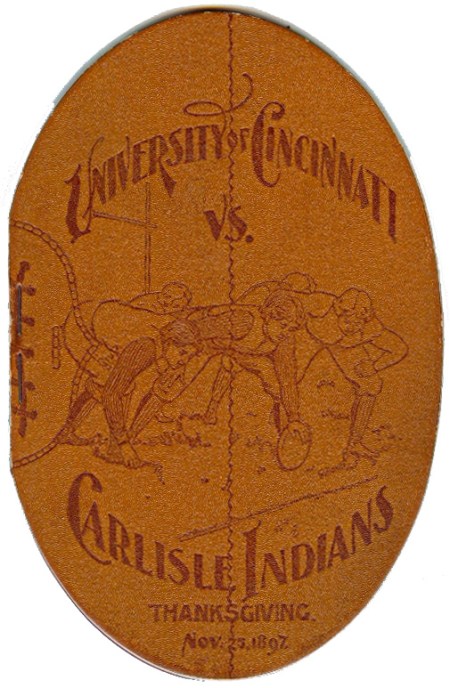
Saturday night, Frank Loney contacted me about a new item he had just acquired. Never before had he been so excited about an acquisition. Yesterday, I went over to look at it. It is simply beautiful. I’ve seen a few old football programs before but none were in the condition of this one for the 1897 Thanksgiving Day game between the University of Cincinnati and the Carlisle Indians. Never before have I seen a 100-year-old program in perfect condition. This one must have been stored out of the sunlight most of its long life. Could it have been a reprint? Frank called the University of Cincinnati archives for an answer to that question. No, no reprint had ever been issued. That Cincinnati didn’t win may have had something to do with that.
In addition to being a historical artifact, it is beautiful. The program is decorated in an Indian motif, likely due to Carlisle being the opponents. This program may not have been in the hands of a spectator because the game was played in a drenching rain. The Indians won 10-0 less than five days after playing a night game against the University of Illinois in the Chicago Coliseum. Carlisle scored all of its points in the first half. According to one newspaper report, “Most of the time of the last half was taken up with fighting.” Isaac Seneca played right tackle. Two years later he would be a first team Walter Camp All-American at halfback. Two days later, missing quarterback Frank Hudson and center Edwin Smith due to injuries, the Indians beat The Ohio State University Medical College for their third victory in a week. The Indians were the only team to defeat Cincinnati, a team that beat Ohio State, Miami, Center College and LSU that year. Chicago was the only other team to beat Illinois.
The program includes a team photo I haven’t seen before and demographic data for the starters. It also includes a photo of W. G. Thompson, the unsung hero of early Carlisle football.
Tags:1897 football program, Artie Miller, Chauncey Archiquette, David McFarland, Edwin Smith, Jacob Jimason, Jonas Metoxen, University of Cincinnati
Posted in Bemus Pierce, Carlisle Indian School, Ed Rogers, Football, Frank Cayou, Frank Hudson, Hawley Pierce, Isaac Seneca, Martin Wheelock | 5 Comments »
July 18, 2008
Jerry, Frank and Tom Pierce were Senecas who lived, at least part of the time, in Irving, NY around the turn of the last century and ran distance races, often in the U. S. In those days athletes often trained and competed under the auspices of athletic clubs. They were the younger brothers of Bemus and Hawley Pierce, the famous Carlisle Indian School football players. The boys also claimed to be grandsons of Deerfoot, aka Lewis Bennett, the world champion Seneca runner of the mid-19th century, who ran races in England while clothed in a wolfskin and feathered headband for effect. The Pierce brothers were affiliated with the Pastime Athletic Club out of Syracuse, New York. In 1901 Jerry Pierce led Pastime A C to the national AAU Junior Championship at a meet held in Buffalo by running his opponents off their feet in the five-mile run. The next day he was winded after the four-mile mark in the senior meet and did not win that race. On July 28 Jerry’s teammates carried him on their shoulders after he fought out a victory in the 3-mile run at the Metropolitan Association of the AAU meet which was also held in Buffalo. On Labor Day, he won the 3-mile run by 40 yards at the Knickerbocker Athletic Club meet held in Bayonne, NJ. Later that year he won the national cross country championship.
Jerry’s success continued in 1902. In late August, his younger brother, Frank, paced him in the Metropolitan Association meet held this time at Celtic Park. Jerry won easily, but Frank, exhausted from setting a fast pace in the 3-mile race, finished fourth. Jerry was suspended by the AAU in September for having accepted a suit of clothing for winning a race. He was soon reinstated but his appetite for racing was waning. His brothers’ weren’t though. Frank was improving and some observers thought Tom, the youngest, was the fastest of the lot. Commentators attributed their success to unorthodox training methods. The Pierce brothers reputedly got in shape by hunting moose and deer on their reservation in Canada.
In 1904 Frank qualified to run in the marathon at the Olympics to be held at the St. Louis World’s Fair that year. In the days before the race, he was listed as one of the favorites. On the day of the race, the temperature was in the 90s in the shade, of which there was none, the humidity was high and the race course ran along a dusty road over which race officials drove automobiles immediately ahead of the runners. The runners had nothing but dust to breathe. Frank was forced to drop out of the race before the 20-mile mark as were several others. Thomas Hicks, the eventual winner was given a concoction of strychnine and brandy by his trainer to give him the energy to finish the race. He almost died after finishing the race.
We’re not done with Native American participation in the 1904 Olympics yet. Next time we’ll look at lacrosse and football.

Tags:1904 Olympics, Deerfoot, distance runners, Frank Pierce, Jerry Pierce, Lewis Bennett, marathon, Seneca, Tom Pierce
Posted in Bemus Pierce, Carlisle Indian School, Hawley Pierce | Leave a Comment »
May 27, 2008
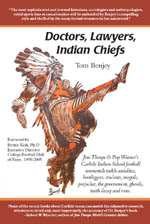
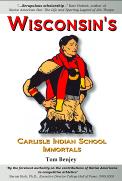
The advance reading copies (called ARCs in the trade) arrived for my new book and are being sent out to reviewers. This is a big moment in a writer’s life: seeing thousands of hours of hard work turned into something tangible. In the old days (pre-computer), ARCs were called galleys, bound galleys or galley proofs. Authors, editors and publishers go over these babies with a fine-tooth comb looking for errors, typos or things that have changed since writing was complete. It is an impossible task because, after all this scrutiny, some typos escape and find their way into the final book. But we try.
Another important use of ARCs is to see how the photos and artwork come out in print. Overall they came out very well, better than expected. But a cartoon about the Oorang Indians from a 1922 Baltimore newspaper is too dim. The challenge now is to figure out how to darken it without losing the detail.
This weekend I received some additional information and a correction regarding Louis Island from a family member who happened to see a previous blog. That was fortuitous because I want the book to be as accurate as possible. This blog is already proving to be of some value. That encourages me to continue with it.
Having these ARCs provides local booksellers the opportunity to provide their customers something extra. People can look at an ARC and pre-order the book if they choose. The bonus, besides being sure of getting a copy of the book as soon as it comes out, is to receive an inscription of his or her choice signed by the author. On-line booksellers also take pre-orders but personalized inscriptions are impractical.

Tags:Add new tag, ARC, biography, book, galleys, Louis Island
Posted in Albert Exendine, Alex Arcasa, Antonio Lubo, Archie Libby, Arthur Sheldon, Bemus Pierce, Benjamin Caswell, Caleb Sickles, Carlisle Indian School, Charles Guyon, Charles Williams, Dickinson College, Doctors, Lawyers, Indian Chiefs, Ed Rogers, Elmer Busch, Emil Hauser, Football, Frank Cayou, Frank Hudson, Frank Mt. Pleasant, Fred Broker, George May, George Tibbits, George Vedernack, Gus Welch, Hawley Pierce, Henry Broker, Hugh Wheelock, Isaac Seneca, James Johnson, James Phillips, Jim Thorpe, Joe Bergie, Joe Guyon, Joe Libby, Joel Wheelock, John B. Flinchum, Leon Boutwell, Lone Star Dietz, Louis Island, Martin Wheelock, Nicholas Bowen, Nick Lassa, Pete Calac, Pete Hauser, Pop Warner, Sampson Bird, Single-Wing, Stacy Matlock, Stancil Powell, Thomas St. Germain, Victor Kelly, Washington Redskins, Washington State University, Wauseka, William Baine, William Gardner, William Garlow, William Newashe | Leave a Comment »

 Tom Benjey's Weblog
