Archive for September, 2023

Which Was Best, 1911 or 1912

September 12, 2023

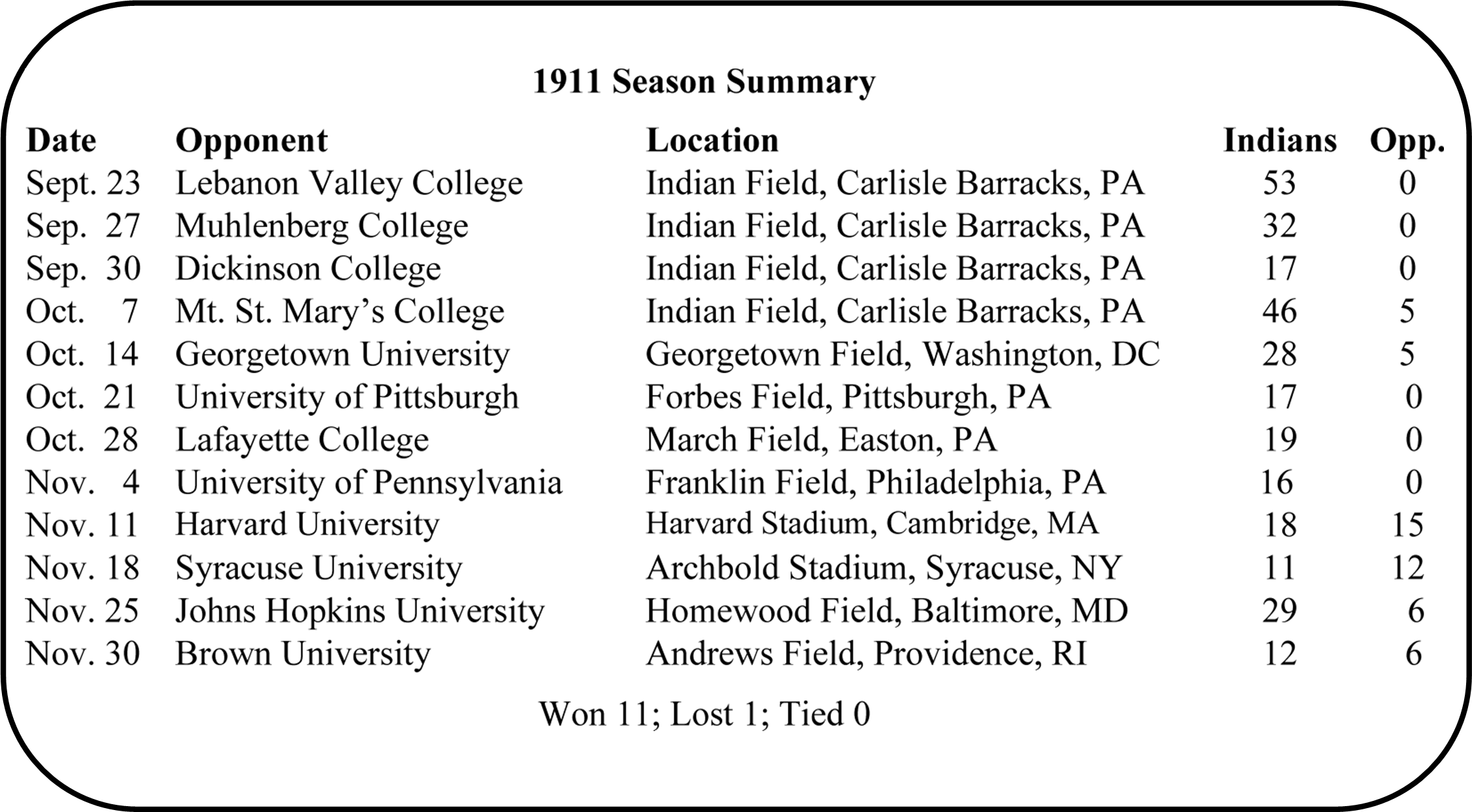
I was recently asked what I thought was the stronger Carlisle team, 1911 or 1912. That is a question that has been raised several times. Let’s start by looking at schedules and results first. The 1911 team went 11-1-0, missing an unbeaten season by a single-point loss to what Warner considered an inferior Syracuse team. They beat two of the Big Four, Penn and Harvard, for only the second time in the team’s history. The Indians scored 298 points while giving up 49. Six teams were shut out, including Pitt, Penn, and Lafayette.

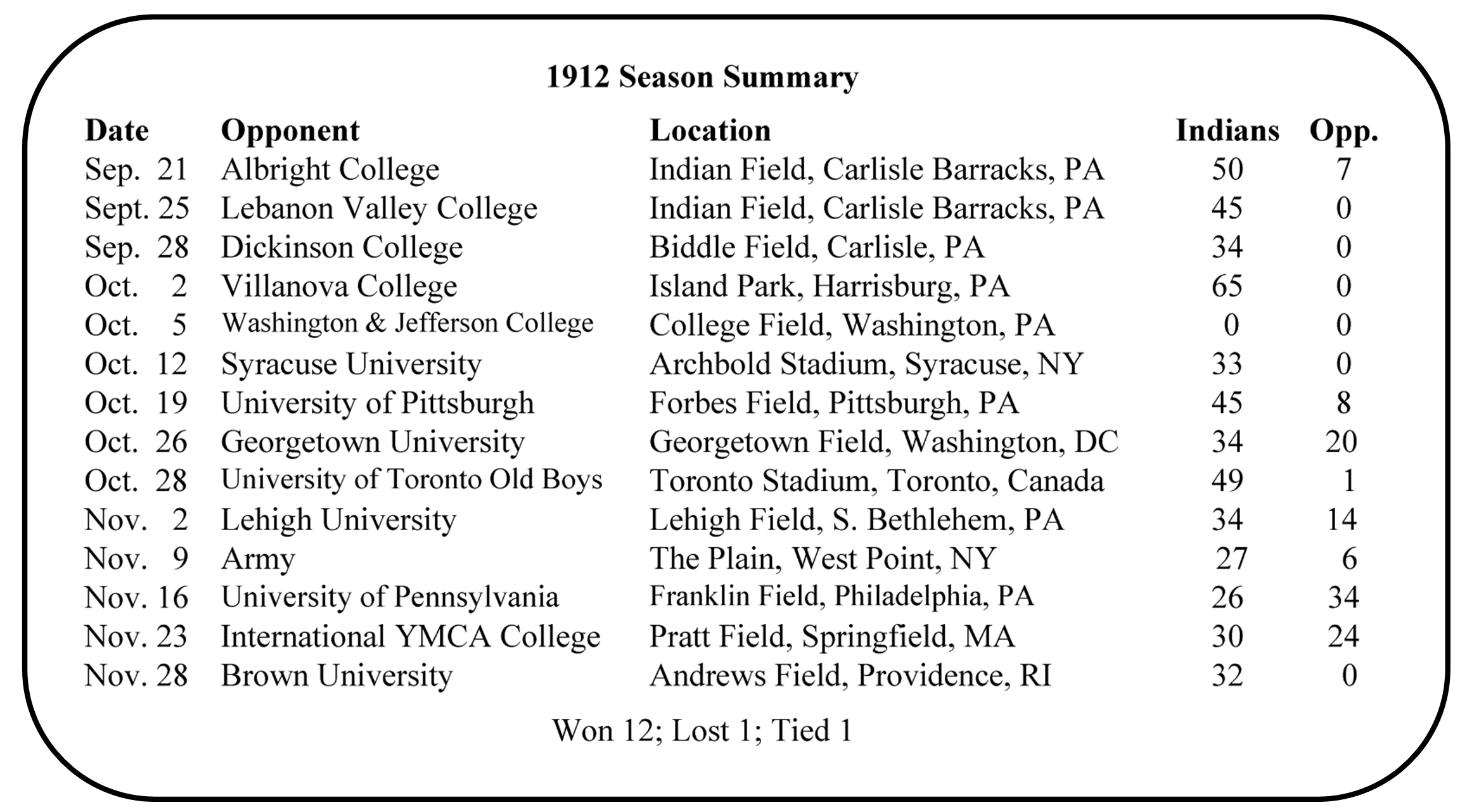
For 1912, like Steckbeck before me, I credited Carlisle with a 12-1-1 record. They shut out five teams where the 1911 version blanked six opponents. They only played one of the Big Four, Penn, and lost to the Quakers. For comparison purposes, I would eliminate the 49-1 game with the University of Toronto Old Boys because the opponent was a rugby team whose players had never played American football. Other Carlisle opponents, even the weakest, knew the rules and had played the game for some years. Dropping the Toronto game reduces Carlisle’s 1912 results to 11-1-1. Eliminating points from the Toronto game from Carlisle’s record leaves the 1912 team with 455 points scored and 113 points given up for the season.

Computing the ratio between points scored over points allowed gives the 1912 team 4.03 points scored for each point given up. The 1911 team’s ratio was 6.08 points scored per point allowed. While the 1912 version was a scoring machine, its defense gave up more than twice as many points, 113 as the 1911 squad did, 49.

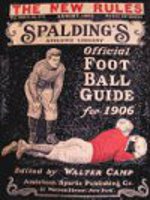
In the 1912 Spalding’s Guide, George Orton of Penn wrote of the 1911 Indians, “…whatever inferiority they may have shown in defensive work, they more than made up by the much greater brilliancy, variety, and power of their offense.”

When evaluating the 1912 team Orton wrote, “…defensively they were not strictly first class.”

Something to keep in mind when reading about eastern teams in the Spalding’s Guides is that articles discussing those teams were written by representatives of IVY League schools who were biased toward those institutions’ teams. They never considered strength of schedule or the fact Carlisle played all its major games away from home.

The 1912 tie, which 1911 didn’t have, was a scoreless affair with Washington & Jefferson. This would be a mark against the 1912 squad. Now, let’s compare the teams’ losses. Warner, through the school newspaper, blamed the one-point loss to Syracuse on a sloppy field to “Poor generalship, poor kicking, and numerous penalties for offside play and holding” and “Thorpe’s kicking and playing in general was disappointing.” Thorpe missed an extra point that would have tied the game.

The 34-26 1912 loss to Penn was due to “the careless work of Carlisle’s backfield, their mistakes on signals, their fumbles, and their failure to intercept forward passes over the goal line, together with a fumbled punt, practically gave their opponents every score they made and enabled Pennsylvania to score 34 points with very little effort on their part.”

Both losses were bad but the one to Penn was worse. Carlisle couldn’t blame its poor play on a muddy field this time.

While researching this article, I discovered an error in Gridiron Gypsies. The season summary table for 1912 did not include the 33-0 victory over Syracuse. It was covered in the text but not in the table. A correction has been sent to the printer but who knows when corrected books will be printed. The corrected table follows.
Historian Demands Redskins Name Be reinstated

September 7, 2023
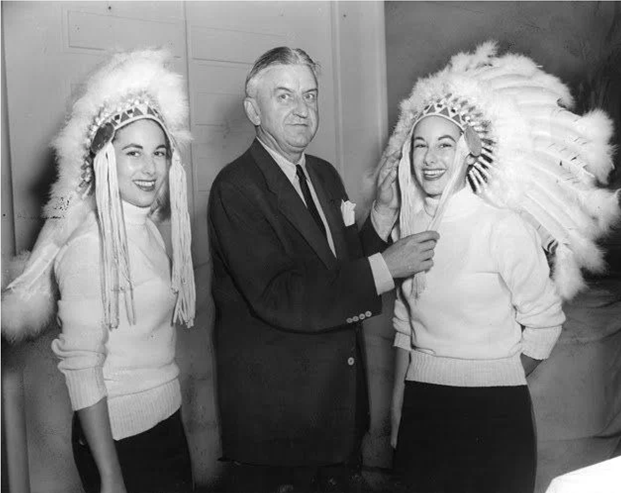
George Preston Marshall (center)

Andre Billeaudeaux, historian and co-founder of Native American Guardians Association (NAGA), thinks opponents of the Redskins name don’t know what they’re talking about. “These people are just ignorant. It’s toxic ignorance. It’s group think. It’s the psychology of a group that has no idea what they’re doing, but they won’t listen to us [NAGA], either.”

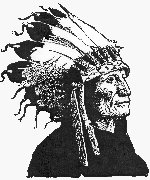
The origin of the Redskins name and logos go back to 1912 when James Gaffney, of New York’s Tammany Hall, purchased the Boston Rustlers National League baseball team. He renamed the team as the Braves and used an image inspired by Saint Tammany for the team’s logo. That image is prominent on the left sleeve of Babe Ruth in a photo taken in 1935.

When a group including Washington laundry magnate George Preston Marshall purchased an idle NFL franchise and established a team in Boston, they named the team the Braves. It was common for upstart NFL teams to name themselves after established baseball teams, particularly when they shared the same field. The new Braves’ uniforms didn’t include an Indian motif. Instead they wore jerseys of a simple design in Marshall’s company’s colors: blue and gold.

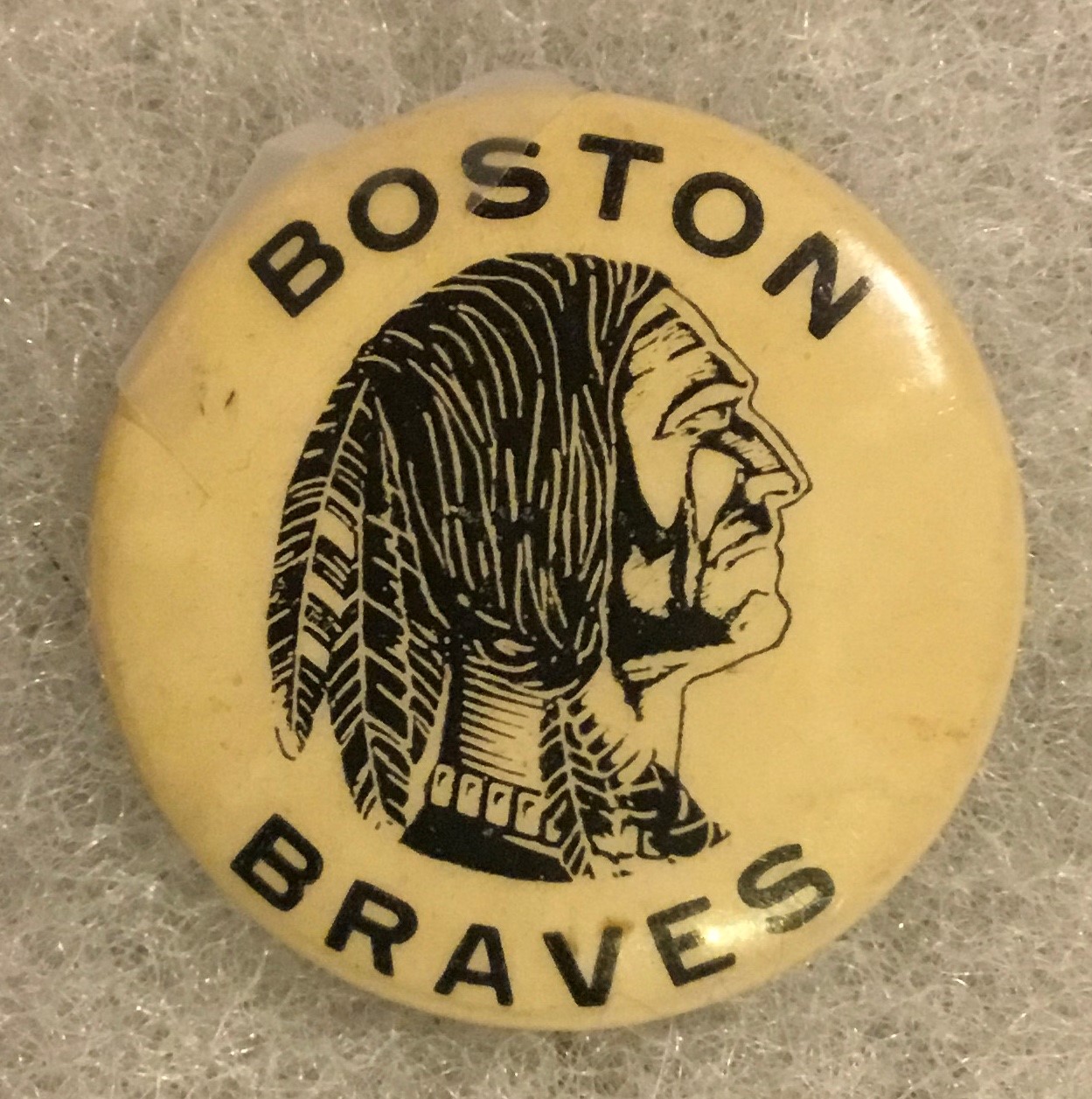
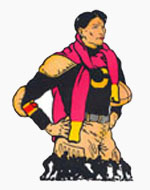
As a .500 first season, Marshall’s cohorts left, leaving him as sole owner of the team. He fired the coach, Lud Wray, and hired Lone Star Dietz, a Carlisle Indian School alum who had had success coaching at the college level. Dietz brought four of his Haskell Institute (today’s Haskell Indian Nations University) Fighting Indians star with him. The figure on the Braves’ letterhead and pin is different than the one used by the baseball team. On the baseball team logo, the man wore a headdress where the football logo image only had three feathers. I’m not qualified to determine if the football team used Saint Tammany’s profile or not. Having red on the letterhead suggests that the team’s colors changed shortly after Dietz became their head coach. The existence of the pin argues against Dietz changing the logo because he was only with the team a short amount of time before the team name was changed and it was during the off season. So, the logo on the button was probably created for the 1932 season.

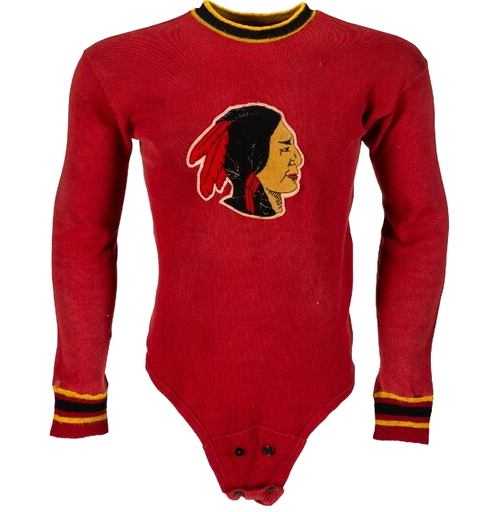
One question never asked is: Why did Marshall change the team’s colors? A 1933 jersey shown below has red as the primary color and is trimmed with gold and black bands. These colors are similar to Carlisle’s colors and the stripes on the cuffs are reminiscent of the below-the-elbow stripes on the Indians’ jerseys. Some have attributed the design of the Redskins’ logo to Lone Star Dietz. The image may have preceded him; it’s not clear when the team adopted it. Dietz likely borrowed the concept from the NHL Blackhawks’ design and placed the logo on the front of the jersey.

Probably to save money, Marshall moved the team from Braves Field to Fenway Park. To eliminate confusion with the baseball team, he felt he had to change the name. Some think red was chosen because they were then based on the Red Sox home field. A Boston newspaper writer claimed that Marshall chose the name to save money by not having to buy new uniforms. As shown in this piece, both colors and design of the team’s uniforms changed when the team’s name changed. However, the team had to wear the old uniforms in the first game of the 1933 season because the new ones hadn’t arrived yet.

Billeaudeaux thinks otherwise. “Redskins is not about race. It’s a warrior who’s gone through the bloodroot ceremony. “They shave their heads and surrender their souls to their Creator. They paint themselves red as if they were born new into the world.”

“The Redskins were the only minority representation in the entire NFL and it was a real person, not a mascot,” said Billeaudeaux. “The name Redskins is a national treasure and for that reason it should be protected. It’s a cultural treasure and deserves to be protected and understood. It’s not just about the football team. It’s about the DNA of the nation.”

NAGA members aren’t the only people who prefer Redskins for the team name. As of this writing, 130,790 people had signed NAGA’s petition demanding the team name be changed back to Redskins. “Redskins Fans Forever,” a Facebook group with 61,600 members, refers to the team only by its historic name. 

Ninety percent of Native Americans around the country supported the Redskins name in a Washington Post poll in 2016, as the woke assault on the traditional name grew stronger.

Red Mesa High School on a Navajo reservation in Arizona recently installed a new football field with the Washington Redskins logo on the 50-yard line.

Redskins Revival Continues

September 1, 2023
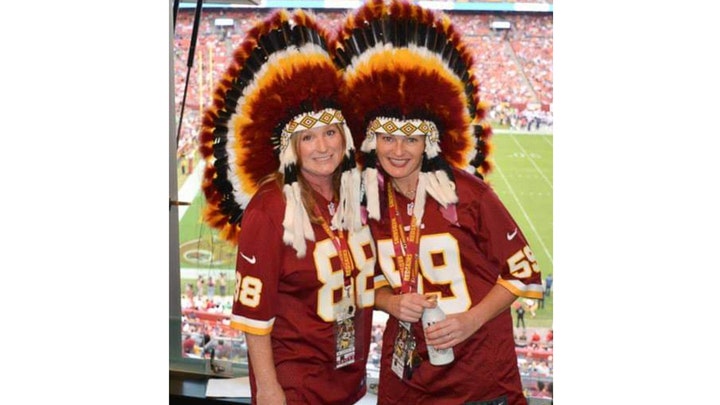
Christina King & Carolyn Steppe in their Redskins regalia

More has happened regarding the Redskins naming controversy. Former luxury-box owner—can you imagine how much the team lost when she dropped it?—Christina King texted “We just signed the petition from NAGA…We [she and her sister Carolyn Steppe] will come back as suite owners when the name reverts back to the Washington Redskins.“ to Matthew Laux, a premium-seat sales manager. She gave up her suite when previous owner Dan Snyder capitulated by dropping the “Redskins” name in 2020. King stated, “We’re Redskins fans, not Commanders fans. We’re not coming back until the name comes back. They’ve taken these images from sports. They bowed to the woke and they’re trying to erase Native American history.” 

Laux responded, “You understand the people that started this petition is a fake group, right?”

That statement did not sit well with NAGA—Native American Guardians Association. Fullblood Dakota Sioux NAGA President Eunice Davidson responded, “We’re not a fake group. We’re tribal-enrolled members from tribes across the United States.” NAGA had posted an on-line petition to have the team’s name changed back on June 21. It stated, in part:

“The name “Redskins” carries deep cultural, historical, and emotional significance, honoring the bravery, resilience, and warrior spirit associated with Native American culture.

“It was never intended as a derogatory or offensive term but as a symbol of respect and admiration. Changing the name abruptly disregards the positive legacy that the Redskins name has built over the years and disorients the passionate fans who have invested their emotions, time, and unwavering support in the team.”

As of last Monday, August 29, the petition had garnered 128,000 signatures.

The NFL team’s spokesperson stated that Laux does not represent the team.

NAGA co-founder, historian Andre Billeaudeux, author of How the Redskins Got Their Name, stated, “We’re in it to win it….’Toxic ignorance’ has fueled the effort by woke professors and academics to erase Native American history from the nation’s sports and pop-culture lexicon .

Team President Jason Wright responded to a question about the name change, “”It is not being considered. Period.”

More next time on the team’s history.