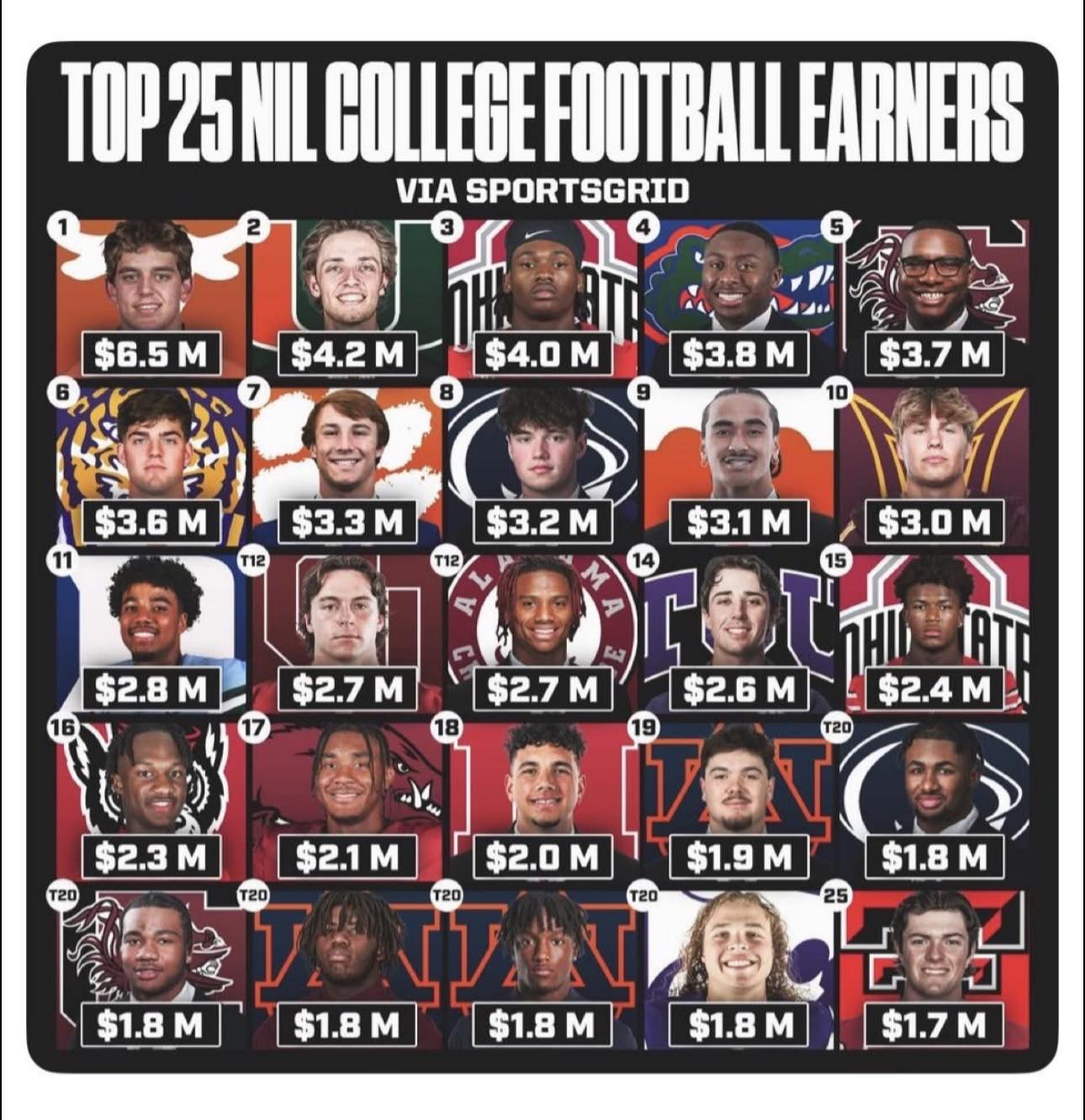
For years, if not decades, Ohio State’s football team has been four deep at every position. When called upon, Buckeye bench players compared favorably with other teams’ starters. Four and five-star recruits have been willing to ride their bench for years, wait for their chance to get into a game. University of Miami Head Coach Mario Cristobal called this “hoarding talent” and said that NIL and the portal have brought it to an end. With schools in the major athletic conferences (SEC, Big Ten, Big 12, and ACC) having committed to paying their athletes about $20.5M a year for the use of their names, images, and likenesses across all sports. NIL groups (boosters) for the schools add more to the pot. How much isn’t accurately known but it is in the tens of millions at the top (in terms of fundraising) schools. Most athletes at Division I colleges get some NIL money, although money spent on athletes competing in minor sports (everything but football and basketball) is generally trivial compared to the millions top tier quarterbacks get.
Even Ohio State can’t afford to pay top dollar to four and five-star recruits who figure to ride the bench at least a year, two more likely. With NIL money now, schools previously unable to attract the most-recruited players can compete for them. Not all, but many. I expect more four and five-star prospects to be signing with the lower-tier teams in the SEC, Big Ten, Big 12, and ACC because those schools may pay them more and give them more playing time than the Ohio States and Michigans would. This factor should make these conferences more competitive. Top-tier teams’ benches will be weaker and lower-tier teams’ starters will be stronger than in the past.
The amounts highly recruited players out of high school will receive will likely fall because of the portal. Curt Cignetti used the portal to fill positions in which he considered weak or not championship caliber. Wanting players who would produce immediately, he emphasized experience over star ratings. This strategy requires saving back part of the school’s NIL pot to have funds available to sign players from the portal after committing to the incoming freshmen. This will reduce the portion of the NIL pot available for the freshmen and will likely lower the amounts paid to the freshmen. There will still be the occasional five-star recruit teams get into a bidding war over but those cases should be fewer and the dollar amounts lower than in the past. We may have reached the peak, if not the end, of freshmen getting $5M paydays.
Schools that don’t field football teams have a massive advantage over those that do because they don’t have to divide their stashes between basketball and football. One example is St. John’s paying guard Tounde Yessoufou upwards of $7M to transfer from Baylor.
While I was writing this article, Curt Cignetti was quoted as saying, “I think players should get paid. But something’s going to have to be done in the next 12 to 24 months, or universities might not be able to handle this. College football won’t exist the way we’re going right now.” To address these issues a bi-partisan bill has been submitted to the senate. We’ll see what happens to it in the political sausage grinder.
Tags: Cignetti, college-football, Football, ncaa, ncaa-football, NIL, Portal, sports
 Tom Benjey's Weblog
Leave a comment