
I stumbled across a video about Operation Thirsty Camel the other day. My first assignment in the Air Force after tech school was to the 405th Armament and Electronics Maintenance Squadron (405th A&E) at Clark AFB in The Philippines. I was trained to maintain MG-13 and MG-10 Automatic Weapons Control Systems on F-101B and F-102A aircraft, respectively because these systems were almost identical. At Clark there were two squadrons of Deuces (F-102s) and no F-101s. The MG-10 system used radar and infrared to track enemy bombers and shoot them down with the missiles and rockets kept inside the aircraft.
One of the squadrons we maintained, the 64th FIS, was relatively new to the base, arriving in 1966. When I arrived in early 1967, all of the Deuces were camouflaged but did not have the large squadron codes on their tails yet. Some of the 64th birds had unusual brackets. Oldtimers told me that the brackets were from the in-flight refueling systems that had been installed on the 64th planes to get them from Paine Field, Washington to the P.I. during operation Thirsty Camel.
Century Series fighter planes were not usually equipped for in-flight refueling, but the Vietnam War heating up necessitated getting more interceptors across the Pacific in a hurry. I was told that two planes were assigned to each tanker, a KC-135, for the flight. Fighters suck up so much fuel that one or the other of the pair was always getting refueled. The fuel usage may not have necessitated that, but it was advisable to keep as much fuel in each plane as possible in case an emergency erupted.
Follows is a link to the video about Operation Thirsty Camel. It’s hokey in places but is a fun watch. The first planes to go weren’t from the 64th. They were from a squadron that was sent to Okinawa. The 64th pilots and birds went a few months later.
UPDATE
Two things happened last week related (in my mind) to this post. First, American interceptors were scrambled to confront Chines and Russian planes over the Bering Sea, and second, The Russians Are Coming, The Russians Are Coming was shown on Turner Classic Movies.
First things first. A pair of intruding bombers, a Russian TU-95 Bear and a Chinese H-6 flew over the Bering Sea, close to American airspace. Three interceptors were scrambled to deter the bogies: an American F-16 and an F-35 plus a Canadian CF-18. The intruders departed without incident. In my day, a pair of F-102s from the 317th FIS at Elmendorf AFB near Anchorage, Alaska would have made the intercept as they did numerous times back then.
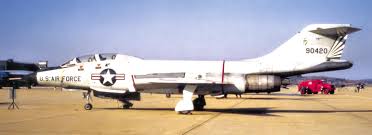
Second. The Russians Are Coming, The Russians Are Coming was set in 1966 on the fictitious Massachusetts island named Gloucester but was filmed in California. The story started with a Soviet (it was the height of the Cold War at that time) submarine running aground by an incompetent crew. Eventually, the Air Defense Command dispatched two interceptors to investigate. A pair of F-101Bs flew across the screen. Since this movie came out while I was in tech school for the MG-13 weapons control system that was used on that model aircraft, it was especially interesting to me. Before that, I hadn’t even seen a photo of an F-101. An odd coincidence occurred because, had it been real life, the Air Force would have sent two planes from Otis AFB in Massachusetts. Based at Otis was a squadron of F-101Bs. With the film being made in California, the nearest interceptors were the F-101Bs stationed at Hamilton AFB.
When I my tour in the Far East was up, which included TDYs to Vietnam and Thailand, I received orders for the 49th FIS at Griffiss AFB in Rome, New York. I looked forward to working on F-101s, the planes the 49th had at that time. However, during my transit from halfway around the world, the 49th’s F-101s were replaced with F-106s from Kincheloe AFB, Michigan. The F-106 started out as an F-102B but so many changes were made, including the weapons control system, I was then working on the MA-1 system, also manufactured by Hughes Aircraft. It used transistors where the MG-10/MG-13 systems used vacuum tubes, the functions were similar. I was discharged on December 26, 1969 without ever touching an F-101.
Tags: 405th Fighter Wing, Clark AFB, F-101B, F-102, MG-10, Thirsty Camel
 Tom Benjey's Weblog
Leave a comment